Showing posts with label The Borders. Show all posts

23 Jun 2010

The elaborate sanctuary of Sir Walter Scott

“It may be pertinacity, but to my eye, these grey hills, and all this wild border country, have beauties peculiar to themselves. I like the very nakedness of the land; it has something bold, and stern, and solitary about it. When I have been for some time in the rich scenery about Edinburgh, which is like ornamented garden land, I begin to wish myself back again among my own honest grey hills; and if I did not see the heather at least once a year, I think I should die!”

        -Sir Walter Scott, as recorded by Washington Irving in 1817 (A Ramble with Sir Walter Scott).

It is 1832, and a team of horses is drawing a coffin containing the body of Sir Water Scott toward Dryburgh Abbey. They reach the crest of a hill, from which there is a commanding view over the surrounding countryside. Without prompting, the horses pause.

They pause because this is where Scott had always allowed them to stop and rest while he had gazed out over the hills and his beloved River Tweed. Such a simple moment, born out of routine, but a moment that provides an intimate glimpse into the depth of Scott’s attachment to the Scottish borders.

“Clausus tutus ero” is Latin for “I am safe when I am enclosed.” This is the motto of Abbotsford, Scott’s home and labour of love from the day he bought it in 1811 to the day he died, his bed having been moved into the dining room so he could look out over the Tweed and hear the sound of the water brushing the banks.

It is safe to say that there was no man as influential in establishing the story of Scotland than Walter Scott. Scott was a proud collector of artefacts that supported a romanticised image of Scotland and the “noble savages” of the Highlands. The entrance porch of Abbotsford House was built to resemble the one in Linlithgow Palace, while the ceiling in Scott’s library copies the one from Rosslyn Chapel.

Scott’s vast collection of beautiful items includes Napoleon’s pen case and a clock that is said to have belonged to Marie Antoinette. The armoury contains both Rob Roy’s broadsword and rifle, as well as his sporran.

On one wall hangs a set of dark, heavy keys that are reputedly from Loch Leven Castle, and in another room there is a lock of Prince Charlie’s hair. Sitting in Scott’s personal study, which contains the desk where he did much of his writing, is the Robroyston chair, made from the roof timber of the building in which William Wallace was betrayed and captured.

Not all of the items Scott collected belonged to famous people. One of the most remarkable items on display at Abbotsford is a small crumbling piece of oatcake, drawn from the sporran of a Highlander who was killed at the battle of Culloden.
When the stock exchange in London crashed in December of 1825, Scott, who had been one of the wealthiest writers who had ever lived, was suddenly plunged into a quagmire of debt.

Not wishing to give up his home, Scott struck a deal to write himself out of debt. Thus began six years of relentless creative output, during which time he earned great sums to appease his creditors but which in the end also caused the decline of his health and ultimately led to his death at the age of 61.

Today the estate is run by The Abbotsford Trust. Along with keeping the grounds immaculately groomed and preserving the many historical artefacts, the trust diligently maintains the ambience of the home as Scott would have designed it. For example, the 9,000 books in the library are arranged in the order that Scott left them more than 170 years ago.
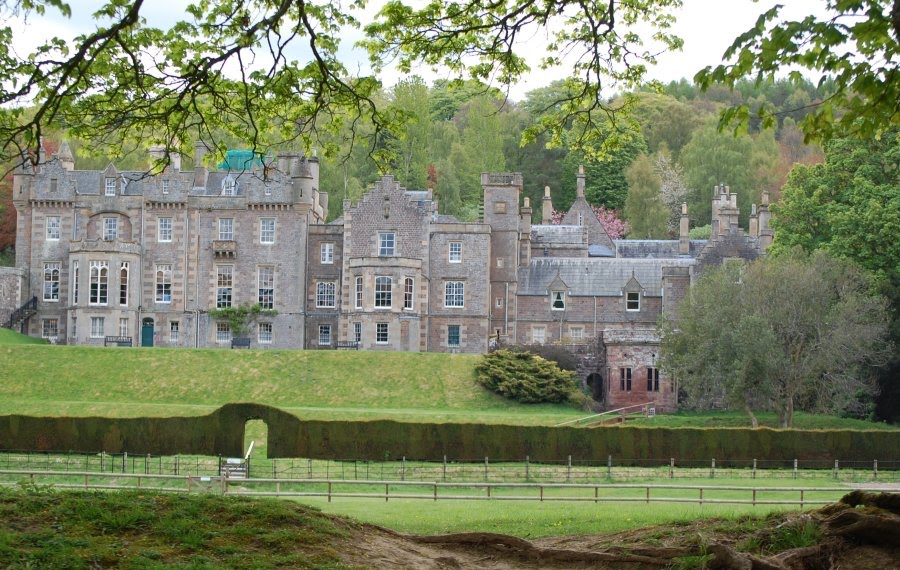
Abbotsford House is a love letter to Scotland built from stone. So much of Scott’s passion for Scotland and especially the borders, went into the decoration of the rooms and the display of his many historical treasures. As a visitor, it is impossible to stand in the dining room and look out at the same view that Scott would have seen during his final days, and not feel surrounded by his great adoration for this place.
Take your time when you visit. Take time especially to walk down to the river and just sit and watch the water, listen to the gentle hiss and burble of it over rocks and earth. When you turn you will see the tree branches framing your view of Abbotsford House, which stands steadfast and lonely, as if it has been waiting all these years for him to come home.
*All photos included of the interior of Abbotsford House have been graciously provided by the Abbotsford Trust. Click here to visit the official Web site of Abbotsford House.

18 Jun 2010

Ink and images: Robert Smail's legacy

I was not firing on all cylinders the day I visited Robert Smail’s Printing Works in Innerleithen. Perhaps this had something to do with the fact that prior to joining the tour I had skipped breakfast and spent most of the morning walking the hills.

Led by costumed tour guides playing characters from Victorian times, I wandered, slightly dazed, over the wooden floorboards, through the room where the waterwheel once churned power for the machinery, and upstairs to the caseroom, where the air hung thick with the tang of eau du ink and wrought iron. This was my favourite room. I loved the light and airy feel of the place, despite knowing that when it was still in use, it would have been cold, drafty and lit by oil lamps.

Modern living sometimes makes us forget the countless small details that go into creating a finished product. The caseroom is a shrine to detail. What initially can be perceived as clutter is actually the meticulous filing of thousands of metal cases, each carved with a tiny letter or number.

This is moveable type, in which the cases are stacked one by one to form words and sentences, with separate cases for gaps and punctuation. When they are all loaded and crammed into a form so they do not shift or fall out, the ink roller is swept over the top, making a sound like a strip of wet Velcro being peeled away.

An aloof looking eagle sits atop the ornate manual printing press, which glides smoothly on rollers to and from its destiny of transferring ideas onto what were once unassuming blank sheets of paper. Words in print. It is still magic.

Throughout the tour my attention was drawn by the numerous photographs hanging on the walls. Along with running the family's successful printing business,  Robert Smail was a keen photographer and with his trusty bellows camera, gathered hundreds of images of local scenes and people. One of the museum staff members said they still have many of Smail’s original plate glass negatives.

They are remarkable photographs, simple but capturing the intricate character of the people and landscape of Innerleithen. I took photos of two of the photos, but the reflection of the glass made it difficult and these shots do not do justice to the story Smail’s images tell.
The printing works is run by the National Trust for Scotland and is open from April to October. Even if you have no interest in Victorian era printing technology, the property is worth a visit just to see these photographs. I may have been too tired to make the most of other elements of the tour that day, but since my visit I have often thought of these photos. If ever a book of Smail’s photographs is published, I shall be among the first in line to buy a copy.
*****************************************************
Thank you for visiting my blog today. I have a surprise banoffee curd update. Having read of my regret for not having purchased a jar of Baxters banoffee curd when I had the chance, my friend Alison (also known around Edinburgh as “Miss Spotlight”) was at Ocean Terminal recently and very kindly bought me a jar.
It is…delicious. Thicker than I thought it would be but so smooth and rich, a perfect mingling of banana and toffee. Sweet. Very sweet. So sweet that if you eat half the jar in one sitting, it will feel like your teeth are disintegrating (Not that I would know anything about this). I have this great idea to make profiteroles filled with banoffee curd and cream, and doused thoroughly in chocolate. I would call them Banoffee Diabetes Balls.

It’s a good thing my veggie box from East Coast Organics was delivered this week. I can offset today’s overindulgence with a weekend of green goodness.

13 Jun 2010

Baxters in the Borders: a foodie's regret

If I am lucky enough to be travelling through the Scottish Borders and I am near the town of Selkirk, I cannot pass up the opportunity to stop in at the Baxters shop.

Baxters has been around in Scotland since 1868 and has several shops around Scotland, but I love this one (just off the A7) because it is like walking into a foodie’s daydream.

The well-lit open plan space includes a section on the left that is dedicated to cookware, although admittedly I do little more than let my eyes pan quickly past so I can focus on everything located to the right, namely the food.

Cunningly, there are samples of various dips set up near the entrance, making it difficult to move past the chipotle, bean and chilli chutney without picking up a jar.
I am a danger to myself and others in this shop. Shelves of biscuits and traditional fudge, a deli with cheeses and handmade chocolates, posh crisps and shelf after shelf of pretty jars of preserves.

When you have tired of samples you can wander into the attached cafĂ© and gaze at the gargantuan desserts behind the glass. Unfortunately I cannot recommend the steak sandwich. Go for the giant scone - I wish I had.
Here is where the regret comes in. I gleefully oggled the jars of banoffee curd, imagining the creamy gooey toffee and banana goodness inside, but in the end I did not buy one. Now if I want one I will have to take the bus all the way to Ocean Terminal to buy it. I know, I know - the trauma. But it’s my blog - don’t mock my pain!
Most people know Baxters because of their soups, but they make truly delightful chutneys and jams as well. I am sure the banoffee curd is also worth swooning over. When I finally do latch onto a jar, I shall let you know.

10 Jun 2010

Melrose Abbey: Carving out a sense of seclusion

Walking along the street towards Melrose Abbey, you can see hints of it over the wall, glimpses of stone through the tree branches. To enter the grounds you must venture through the ticket office, and it is not until you have paid your fare that you can step into the sanctuary and stand before the remnants of the Cistercian monks' “architecture of solitude.”

This is a wonderful moment.

You are greeted by a collection of high rose-stoned arches, mouths on the verge of saying something but frozen before the words can spill. Your own mouth automatically opens in response, emitting one of those little gasps that needs no further explanation. With that, a silent understanding passes between you and this ancient place.
The foundations were first laid for the abbey in 1136 and after 200 years of relative peace it took its first thorough beating by Edward II’s army in 1322. Robert the Bruce supported the abbey’s repair, and it is here that The Bruce’s heart is buried, while his body lies in Dunfermline.

If you have been to other parts of Scotland and seen the magnificent statues dedicated to the man, looking down at the small round plinth that marks the place where his heart now lies is a strangely moving experience.
If you are lucky you will see the abbey on a morning that still has some mist left to burn, as it will be easier to imagine the “white monks” as they were called, moving through the grounds and beneath the high ceilings, their rough undyed woolen habits chafing against cold skin (for they wore nothing else underneath those coarse garments).

With so many hours of the day dedicated to religious discipline, the only way the monks could maintain their order was to include men who could shoulder the bulk of the manual labour. For their efforts the lay brothers were allowed privileges such as more sleep and extra food. When you think of a life that included having to get up “when sleep is sweetest,”* those extra hours of rest (even on a hard, uncomfortable mat) would have been welcome indeed.

However for an order that was dedicated to work and poverty, it is curious to read how the abbey also became one of the most wealthy in the country, thus attracting the wrath of the English during wartime.

When Richard II’s army stormed the Scottish Borders in 1385, they destroyed the abbey. Content with the idea that the people of Scotland’s border country had been well and truly subdued, Richard then turned around and financially supported the abbey’s rebuilding.
Using the warm pinkish sandstone quarried from the nearby Eildon Hills (I think of this tone as “sun burn chic"), the abbey slowly emerged into a medieval masterpiece, its exterior pin cushioned with the kind of extravagant carving that still awes people today.

The guidebook says that the most popular carving is one of a pig playing the bagpipes, but if you are a lover of gargoyles, you would likely rather stand beneath these open-mouthed beauties and wish for a thunderstorm.
After your feet have crunched over the loose gravel below, one dizzying step at a time over worn stone steps will find you high up the bell tower, where the view over the surrounding countryside is nothing short of wondrous.
In 1544 during the War of Rough Wooing, the English set fire to the abbey again, and despite repeated attempts to draw support to return the abbey to its former glory, it was left to crumble. The remaining monks’ numbers slowly withered and the last monk died in 1590.

Not surprisingly, Melrose Abbey is one of the most visited sites in the Scottish Borders. Tour buses can start arriving shortly after opening, so once again an early start it recommended if you wish to capture for yourself some precious pieces of solitude that a brotherhood of monks once tried to render in stone.
*Quote from Abbot Aelred of Rievaulx (1147-67): “Our food is scanty, our garments rough; our drink is from the stream and our sleep is often upon our book. Under our tired limbs there is but a hard mat; when sleep is sweetest we must rise at bell’s bidding…Self will has no place; there is no moment for idleness or dissipation…everywhere peace, everywhere serenity and a marvellous freedom from the tumult of the world.”

21 Apr 2010

Traquair Ales: A taste of history

One of the best things about eating and drinking in Scotland is how easy it is to stack pleasure onto a sensual experience by adding the often remarkable history behind it.

So in the spirit of layered pleasure, humour me and imagine you are drinking a beer. Not just a beer but an ale - dark with a cream coloured head. Still holding onto your glass, transport yourself back to the 1700s.

You are a worker on an estate that dates back to 1107, and the beverage you are holding, made using the fresh spring water that flows nearby, makes up a substantial part of your earnings.

Then in the 1800s, stand in the brewery as it falls silent. Dust gathers around all of the brewing equipment, including the massive oak vessels used to ferment the beer.

One hundred and fifty years go past, and the new owner of the estate is digging through the disused brewery, uncovering the oak tuns. He thinks about the fresh spring water that still flows through the property and an idea strikes like a match in his mind. Soon the ale is flowing again.

Fast forward to today. You are looking through a window into a small room where those same four unlined oaks vessels are still doing their job after all these years.
They are so precious that when they are not being used for brewing, they are kept wet with steam hoses. They are never allowed to dry out, because the wood would crack and warp, and if they are lost they cannot be replaced. The species of tree from which they were made - the memel oak- is no longer available.

Take another sip from that glass in your hand and try to tell me it’s just another beer.

Traquair Brewery will never be big. They will never take the world by storm and flood the market with rich, uniquely Scottish ale. Because if they took the leap into mass production they would have to change to the modern lined oak casks. This means the flavour would change. The brewery would change. And they have no intention of changing.

I recently had the opportunity to visit the brewery and sample all four of their bottled ales(their Stuart Ale is only available on tap from a handful of pubs around Scotland). 

I rarely drink alcohol and by no means do I possess the confidence to cover my opinions in gold leaf and call it Truth, but I will say this about these ales: they made my mouth very happy.

All the Traquair ales are considered winter ales because they are heavy and dark, with the Bear Ale being the palest option of the lot.

The Traquair House Ale, the variety that put the brewery back in business in the 1960s, is their most popular and widely available. Gus, The brewery’s shop manager, recommends balancing the fruity warmth of the house ale with an acidic cheese like an aged cheddar.

The Bear Ale was my least favourite, perhaps because the sting of the bitterness reminded me of what I dislike about lager. Overall I preferred the smooth flavours of the dark ales.

The most powerful flavour comes from the brewery’s newest offering, the Laird’s Liquor. Sip this to feel a little cloud of liquorice lingering on your palate.


My favourite was the Jacobite Ale, which pours like liquid midnight thanks to the darkly toasted malt. It is round and full and leaves a spicy tickle in the throat, due to the added twist of coriander. Gus recommends a curry with this one -anything with chillies.

It is best to drink these ales at room temperature, and by room temperature that doesn’t mean our often overly warm modern homes. Think of the cool comfort of a stone cottage in late spring and aim for that.

If you aren’t in Scotland and are salivating to try some of these ales, Traquair is available from some specialty shops around the UK, and does export to some parts of the USA, Canada and a few countries in Europe. If you are in the USA your best option is to check in with merchantduvin see if it is available in your state.

I have a full list of retailers and importers so if anyone wants to check whether Traquair ales are available in a specific area or country, email me or leave a comment.

When people think of Scotland they often think of whisky, and after this experience I wonder if these crafted Scottish ales aren’t getting unfairly left in the corner. My visit to Traquair was my first foray into Scottish ales and I hope to visit many more breweries in the future.

All that remains is to thank the folks at Traquair House for the use of the photos (only the highly unprofessional one below is mine). I didn’t think to take photos when I was sampling the ales at the shop. Then I forgot my camera at a follow-up tasting session with my slow food group later in the week. Nevermind.

Now then, hold out your glasses and I’ll pour.

14 Apr 2010

Leading you by the nose to Traquair

There is something important you need to remember when you visit Traquair House. It is this:

You can reset your nose by sniffing your skin.

I only learned this fact yesterday. Had I known it before stepping over the threshold of Britain’s oldest continuously occupied house, it would have saved me from wandering in and out of the rooms like an addict looking for another hit.

It is widely known that Traquair was used as a hunting lodge for kings and queens, and later as a safe haven for Catholic priests during the days of the Jacobite uprising.

The house is also recognized as a valuable piece of Scottish history, for its collections of artefacts and in the way the Traquair Brewery has sought to revive the traditional ale making techniques that were used there in the 1600s.
What is not widely known is that Traquair House smells amazing. Indeed, it is the best smelling house I have ever visited.

Every room seems to tell the nose a different story, from the cool stone scent that wraps around you when you enter the long hall to the vaulted cellars, to the stewed incense-like aroma of oil paint, wooden beams, and the ghosts of fires that once burned in the grate, which hovers in the high drawing room in the same way dust appears to be trapped in sunbeams.

Also, whoever among the staff thought to put the enormous vase of lilies in the lower drawing room that is attached to the dining room, ought to be given a raise.
The entrance for these rooms is off the courtyard at ground level. Imagine the transference of fragrance stepping from outside, where the sun is warming the stones and the spring flowers and grass are pushing sweetness into the air, and into these slightly cooler rooms, which are blooming with the collective smell of oil paint, wood polish, and the syrupy whiff of aging fabrics. Overtop of all of this, float the siren song of lilies. It was, in a word, divine.
I had to walk out, take a turn around the courtyard and go back in again, just so I could feel my body go slightly limp with the pleasure of it.

If I had known about resetting my nose I would have simply sniffed my arm occasionally and stayed in the room for half an hour, despite the fact that the poor girl acting as the room’s guide would have thought I was a loony. Even loonies must have their pleasures, thank you.

I wasn’t allowed to take photos inside house but the folks at Traquair have forwarded me some images. There is just one I want to share, of the main library.
From this photo I think all book lovers can imagine what it smells like. Sweet old leather and the dust that has still managed to creep between the tightly pressed pages. I can’t be the only one with a desire to open a few of them up and let their aromatic secrets fill the room.

Several of the rooms include recordings made by the current owner. In a gentle voice perfect for storytelling, the 21st Lady of Traquair, Catherine Maxwell Stuart, takes visitors through the history of the items and interesting anecdotes from her family’s past.
My favourite stories include a visit from Mary Queen of Scots with her infant son, who would become King James IV. The cradle where he slept is at the foot of the bed in what is known as The King’s Room.

The other story that grips me is about the secret stairway used by Catholic priests and Jacobite refugees, prior to the Catholic Emancipation Act of 1829. The false backing of the cupboard has been opened to reveal the steep stairs behind, making it easy to imagine someone trying to silently sneak away while his room was being searched.

The one room that I expected to hold a heavy scent of history was the Catholic chapel, however it was as if those aromas had been scrubbed away. I later learned that this is because the chapel is above the brewery. The incredible beer that they brew here will be getting its own post.

It was too late in the day to get a decent photo of the huge maze at the back of the house, so I will introduce you to the resident goat instead. Everyone, this is George. George - everyone.
One last thing about the house. These are the Bear Gates, which have been shut since 1744, when the fifth earl of Traquair closed them following a visit by Bonnie Prince Charlie.

The Earl swore they would not be reopened until a Stuart king took the British throne. The grass has grown over the gate near the bottom, and everyone visiting the house continues to use the “temporary” access.
This house is magnificent. It is only open during the summer season, starting from Easter. During the off season it is still lived in by Lady Catherine and her family.

We will be sampling Traquair Ale in a forthcoming post. And if you don’t fancy a visit to this house already, I promise it will make you change your mind.

  © Blogger template 'Isolation' by Ourblogtemplates.com 2008

Back to TOP