Showing posts with label Military History. Show all posts

12 Apr 2011

Welcome to Romantic Roslin Glen

Hello you. Welcome to the two year anniversary of this wee blog dedicated to the sensual pleasures of Scotland.

For me it would not be a celebration unless I indulged in some kind of enjoyable excess, so I invite you to the following photo heavy tribute to the many beauties of Roslin Glen and the River North Esk.

The splendour begins not long after we leave the village of Roslin, the name for which is formed of two Celtic words, Ross - a rocky outcrop and Linn - a waterfall.

Looking now through all the layers of springtime green, it is difficult to imagine a time when these fields would have been stained with blood. On February 24 1303, Scottish and English forces clashed here for the 3rd battle of Roslin, an event when saw a Scottish victory but also horrendous casualties.
Today the sun is out and as we meander the path between fields and forest we think “this is nice,” because it is. Open space, clear air - a pleasant country walk.

But when we take the turn to follow the river walk, everything changes. Suddenly get a view of the valley that stops us in awe because we didn’t expect this kind of romantic scene.

Once we can move again we thump down worn stone steps, stopping half way to follow a butterfly from blossom to blossom with our camera.

Our route, referred to in the guidebook as The Riddle of Roslin, directs us along the river trail, but it is impossible to resist a detour to see the remains of what the local information boards call Maiden Castle.

It is thought that sometime during the late bronze age and the iron age, between 1000 BCE and 200 AD, this ridge above the river was home to a large family group. This was not a castle as we might think of it, but simple roundhouses and some minor defences of stone banks and deep ditches. With the surrounding forests and the fish-rich river for food, a family could have thrived here.
Today, if it weren’t for the information boards to advise us of the history of this place, we would walk unaware through the ghosts of our bronze age ancestors. We are always trying to revive our pasts, while nature feels no such need to cling. She moves on, grows over, lives today.

Finally we begin to explore the banks of the river, which are bulging with green and fresh stems and the pristine white petals of wood sorrel.

The river is high and slow from spring rains and moves gently past banks that are so thick with plants it is as if life is something that can be purged in one great heave.
Nearby old trees take a humble back seat to all the countless new shoots. They allow the wind to stir their branches, whisks inside an infinite bowl. At the water’s edge their roots wrap like fat baby knuckles around plates of ancient glacier stone.

I tell you, there is no way to photograph all of this. Everywhere around us, birdsong bounces back and forth like a room full of grandfather clocks, time reduced to a ball that no one can catch.
We walk for a long time, trying to follow the book but often veering onto this path or that, just letting ourselves wander, to spread out and discover.

Like when we come to he place where rust-coloured rocks overhang the trail and remind us of scenes of the grand canyon. High above us we can see small caves and we long to look in.
This desire intensifies a short while later when we look across the river to see Wallace’s Cave, named for Scotland’s national hero, who took part in the Battle of Roslin.

With no way to get to the other side and explore, we will have to make do with this video from BreatheScotland.

The cave is also associated with Hawthornden Castle, which stands across the river, somewhere beyond the clutter of tree branches.

Hawthornden Castle was built in 1638 by poet William Drummond. A little research has brought me to the brink of jealous delirium as I have learned that part of the castle is now used as a retreat for writers and artists.

Each year the Hawthornden Castle Fellowship offers five writers a place here for a month of seclusion. It’s alright if you need a moment to let the idea sink in. We have time.

Somehow we are nearing the end of our walk. Already? Well believe it or not, we have been away for hours.
We’ve taken so many detours and stopped so many times to try and memorise the exact undertone of sweetness in the air, that by the time we have journeyed through the last of the forest trails and are making our way up the stairs and through the archway leading to Rosslyn Castle, we are well and truly knackered.

The castle was built after the battle of Roslin, but much of it was destroyed by fire in 1447. The only part that is still inhabitable is the five storey house that was built as part of later restorations. If you are feeling particularly burdened by cash, you can even stay here.
For the moment let’s set aside plans to visit the famous wee Rosslyn Chapel. We’ll wait until the construction work for the new visitor’s entrance is finished, and hope that visitors will once again be able to at least get close to the outside of the chapel without having to shell out the £7.70 entrance fee.

Thank you for reading. Over the past two years I have so enjoyed sharing my  adventures on this wee patch of the internet. I enjoy all manner of enthusiasm and supportive comments. You are welcome for cake anytime. Let’s have a seat just here and enjoy a bit of sun, shall we?

11 Mar 2011

Salute to The Black Watch Museum

The kilt in the glass case looks heavy, a sleeping pleated quilt. The mud that is crusted in large smears and droplets has faded to the hue of desert sand.

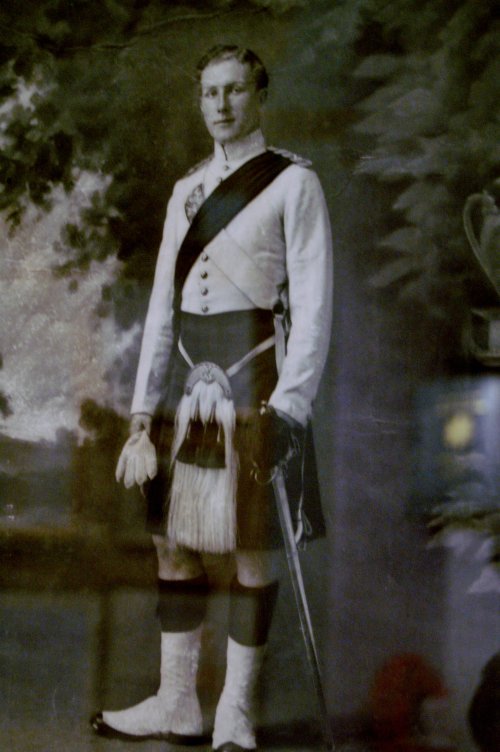
A black and white photo of Captain WD MacLean hangs on the wall above the cabinet.

In the photo he is seen in the same kilt, which he was wearing when he fell in Flanders in WWI. High on another wall is a cross that bears his name.

Of the ten rooms which tell the chronological story of The Black Watch, Scotland’s oldest regiment, it is this room which holds my fascination the most. I think it is the multitude of personal touches which makes the difference.

While you look around at the artefacts, the voice of veteran Gilbert Crossland follows you, his stories of life in the trenches bringing to life the silent relics of his dead comrades.

Just outside the room a life-sized model of a WWI soldier stands in a sandbagged trench, his gun poised and ready to fire. The frozen look of worry on his face and the fine details of his hands around the rifle add a sense of distant sadness to the scene. It is like a postcard for so much human regret.

The Black Watch Museum is housed in Balhousie Castle, which itself has a long and varied history, from its start in the 15th century to its use as a convent in 1926 and later as the Auxiliary Training Service as officer’s quarters during WWII. Located just outside central Perth, the grounds of the castle roll close to the banks of the River Tay.
For those with a penchant for facts and a fascination with military history, The Black Watch Museum is a gold mine of information. Starting with the regiment’s formation in 1739 through to modern warfare in the Middle East, there are endless lists of battles and dates, rows of medals and military equipment on display.

But while it may be easy to appeal to those who could happily absorb every strategic battlefield manoeuvre, it can be difficult for historical attractions like this to attract those who find it harder to maintain attention through reams of dates and facts. Most teenagers for example. Or (and I have narrowed this down in order to avoid casting any vast generalisation on my gender)…me.

What is necessary in these situations is the inclusion of story fragments. Take one day, one hour, one person, and pluck them out of the quagmire of history. Hold the spotlight on just that one moment and you will find you deepen people’s understanding of the wider narrative.
So when you sit down to view the model street scene set on the Dutch-German border in February 1945, a recording will talk you through a one-day experience of the 5th Battalion Black Watch, the sound of gun fire and small glowing lights moving your mind through the action. Small details, like the tiny burned bike leaning abandoned against the charred building, will stay with you as if they were life-sized.
Sometimes a single item is the loose thread from which a timeline of history can unfurl. On one floor a model of a piper holds a set of bagpipes that were played by Piper Smith of the 42nd Battalion The Royal Highlanders of Canada during the Retreat to Mons and at Vimy Ridge during WWI.

Later in WWII it was Canadian officer Jack McBride who played these pipes when he served as a Canadian Loan Officer with the 7th Battalion The Black Watch in Northwest Europe.

In another room behind the glass of a simple frame is the cracked black and white photo of a smiling Private W Lambton, MM 1st Battalion The Tyneside Scottish. There is so much innocent pride in his expression, telling the story of so many young men with grand ideas of war and glory.
Perth is famous for its natural beauty and outdoor lifestyle, but this unique museum offers a new understanding of Scottish history.

For £4 you can wander the halls of a castle and either pour over dates and facts or lose yourself in the stories of the men and women whose own histories are forever entwined with this famous regiment.

For more information on The Black Watch, visit the official website. Undiscovered Scotland also features an excellent article about the museum.

11 Nov 2010

Remembrance Day: Black Watch Memorial

Gazing out over the Perthshire landscape next to where Wade’s Bridge crosses the River Tay, the stone monument of a Black Watch soldier stands on the outskirts of Aberfeldy.

Unveiled in 1887 at Taybridge, it had been intended to be erected on the other side of the river, the actual site of original mustering of the regiment’s troops. However with the fields prone to flooding, the closest practical spot was chosen instead.

In 1910 a lightning strike split the monument from top to bottom and repairs included the addition of a lightening conductor.
The monument depicts a soldier wearing the old regimental uniform. The companies wore dark tartans in order to distinguish them from the “Red Soldiers” and this led to them being known as “Freiceadan Dobh” or “The Black Watch.”

Away from the lights of the town centre, dusk descends like a blanket around the monument. The small green space that surrounds it descends to the river bank and draws the eye towards the stunning view of the snow-dusted hills.

If you don’t already know it is there, you have to be quick to turn off before you are already over the bridge. If you have a chance, it is a perfect spot to stop and enjoy a moment of reflection, looking over the fields where those men would have first gathered all those years ago.

14 Mar 2010

Bothwell Castle: Medieval vision to jackdaw paradise

Imagine that you are clutching in your fist the stamp of your grandest ambition. Imagine raising your fist into the air and bringing it down onto the world, as if to gouge out a pothole in the highway of history. Finally, imagine more than 700 years washing over that stamp of yours, and how those years alter the contours of your once pristine vision.

Once upon a time, Walter of Moray, ancestor of the Murray clan, stood atop a hill looking out over the River Clyde. Up went his fist and down came the mark of his aspirations, to build the grandest castle Scotland had ever seen.
The groundwork was laid in the late 1200s, with plans for a fortress covering 1.8 acres. It began in spectacular fashion, with the construction of a massive circular donjon (also known as a keep), a central tower where the lord and his family could live as well as defend themselves even if the rest of the castle was under siege.
Today it still stands 27 feet tall, but then it was also 20 metres in diameter, with walls five metres thick. It even had its own moat. The genius of its design included a private escape route from the lord’s chamber through to the adjacent prison tower and its external stairs. Also, take a look at the photo below:
Do you see the long pointed hump on the right hand side? The entrance to the donjon is tucked around the corner to the right of that seemingly insignificant structural addition. The architect knew better protection lay in ensuring no battering ram had a clear run at the entrance from the courtyard. There is a greater chance of defence when your attackers are trying to manoeuvre a massive log around a bend at speed.

Inside the keep, the basement was thought to have been used for storage, while the upper floors were used as living quarters. From down here it is easy to feel you are being swallowed up, while above you the jackdaws wheel and turn, flying in circles through open archways before stopping to roost on wide ledges.
Follow me now through the doorway and into the stairwell, an enclosed stone corkscrew that looks deceptively still, like at any moment the rocks will emit an almighty crunch and plumes of dust will detonate from long silent internal gears. Then you need only to stand there and be lifted, like a music box ballerina, into the sky.
Murray’s dream was cut short by the start of the wars of independence, thus beginning the pinball game that saw Bothwell partially destroyed, taken over, rebuilt, partially destroyed again, and so on throughout its history.

It was one of Murray’s own descendants - Sir Andrew Murray - who, after forcing Edward III to hightail it back to England in 1337, reclaimed and then laid waste to his ancestral home, both as a partisan obligation and a wartime strategy.

Enter the Black Douglases and Archibald “The Grim.” Having married Lady Joanna, the wealthy heiress of the Murray estates, Archibald set to work rebuilding the castle in 1362. Archibald’s son went on to expand and alter those additions begun by his father, which included linking the donjon and a new tower house with a massive curtain wall.

Across the courtyard from the donjon lies the southeast tower, and it is thought it was the son who added the flourish of defensive slotted parapets around the top. I love how I see them as something pretty, like an iced fairytale cake turned to stone, when their actual purpose was straightforward and practical.
William Murray’s grand design took another turn when the Black Douglases were overthrown in 1455. Eventually Bothwell was handed to the Red Douglases in 1492, but by the 1600s the medieval fortress was losing its lustre for the family and they dismantled parts of it to build a new mansion not far way. For years and years Bothwell festered and faltered and clung on, before being placed in the care of the state in 1935.

Today Bothwell Castle maintains its dramatic position above the Clyde, and has become a haven for those lively jackdaws. They are everywhere, appearing suddenly from darkened corners and exploding in wild fervour from the tops of the towers.

Nearby there is an extra secret to this place. When you leave the castle, follow the path down to where it meets the trail that runs along the river. Not far from this crossroads is a wonderful tree whose trunk resembles the sleeping face of some magical creature, like something out of a Tolkien novel.

Of all the Scottish castles I have visited so far, none has captured my imagination like Bothwell has. Perhaps it is because it is so very old. Perhaps it is William Murray’s grandiose idea that still blossoms in my mind, all these centuries later. Or maybe it is just the jackdaws trying to tell me something.

  © Blogger template 'Isolation' by Ourblogtemplates.com 2008

Back to TOP