Showing posts with label Sutherland. Show all posts

12 Jan 2010

Turn here for Tarbet


After the winter we have had so far, I feel in need of an escape. So we turn and drive three miles off the main (albeit single track) road to a tiny cove in the north called Tarbet.

It is early spring, and as you descend from the eerie grey-brown expanse of the northern highlands, this place is like a hiccup of green before the silver blue of the sea takes over.


It can be a place to rest and linger for a few minutes (or hours) before continuing your journey, but for many people it is a the leaping off point to Handa Island and its protected nature reserve. Boats take tourists out to the island between April and September, and visitors are given three hours to wander the seabird-laden mass of red Torridon sandstone, careful not to peak too far over the edge of the sheer cliffs.

We landed in Tarbet almost by accident, deciding on a whim to take the narrow road that led down to the shore. There was something so idyllic about the place, from the small piles of fishing nets near the dock, to a trio of geese waddling up from the shoreline. There was a dilapidated stone wall running up the hillside, near which grew the most wonderful storm-beaten tree. Its trunk and branches bent by the constant wind, it seemed to be reaching desperately inland, simultaneously blooming and attempting its escape.

With a long drive ahead of us we weren’t able to take the day to visit Handa Island. However from what I have read and the photos I have seen, it seems like a magical place. If anyone has been before I would love to hear the story of your visit.

19 Nov 2009

The enduring mystery of the Farr Stone

Scotland is one of those places where it is worth travelling a long distance for a piece of stone. The curving spine of an old wall, the crumbling nave of an ancient kirk, and the fading, interlocking knots chiselled by hand hundreds of years ago.

In the north of Scotland near the crofting village of Bettyhill, sits the old Farr Church, which now houses the Strathnaver Museum. The graveyard surrounding the church would not look to be anything special, except for one giant, weathered monument jutting from the ground.


Six feet high and thought to date from around the 10th century, The Farr Stone is one of the best early examples of Celtic art. So far I have found very little information about the stone, which is still remarkably detailed despite enduring centuries of a harsh northern climate. I regret not having gone into the museum to ask more, but at the time I just wanted to stand next to something so very old, and wonder.

I don’t know whose grave the stone would have marked or what that person did to deserve such an intricate work. You can still see at the bottom of the cross, two creatures that look like swans, their necks entwined.

It has been so long, this stone stands as a mark to a growing sense of secrecy. The surrounding countryside is rough and beautiful, with remains of early villages interspersed with sandy beaches and dramatic views towards the estuary of the River Naver. The museum is dedicated to keeping alive the stories of the early crofters and how they were affected by the clearances. All I can think of are the ghosts of a man's warm hands against this rock, his fingers moving through the grooves he had carved.

Despite its lonely stature and isolated placement, the stone is not without its very alert and suspicious guards, who wander the grounds pretending to examine the lawn. One thing is certain; if they have solved the mystery, they don't seem interested in sharing.

29 Jul 2009

Inside the limestone belly of Smoo Cave

For thousands of years, a snake-like inlet has allowed the sea to dig away at one side of a limestone cliff, while a burn has licked through from the other direction. The resulting gap resembles a frozen, malformed mouth, the kind your mother used to threaten you would end up with if you kept on pulling those ridiculous faces.

Approaching Smoo Cave at ground level, the rugged ring of masonry circles only blackness. Walking inside could mean being swallowed, taken through a veil into another, decidedly more dreadful world.
The small plants that clamour over the mounds of earth just inside the entrance seem to glow, a heavy undertone of yellow pulsing through the green like a greeting card from photosynthesis. The green on the inside walls casts a different, slightly sickly radiance, reminiscent of kind of damp underworld Gollum would call home.
Deeper inside, a waterfall collapses from a hole in the roof into a dark pool. Far from a sense of gentle reprieve, you feel a desperate urge to find a small boat and head as deep as possible into the cave. It doesn’t matter that others have been before. You are sure that there is something in there, something only you will be able to glimpse.
Taking history into account, this is the perfect place to haul up with a load of contraband whisky. The ideal spot to lure an enemy, to duck inside one of the smaller inner chambers and wait, breath held in your throat, for the footsteps that will tell you when to strike. A formidable place for a brave soul to endure a solitary standoff against the devil himself, the breaking dawn striking the final blow against evil. Imagine how such a story would relay to eager ears. After all, what gruesome tongue might loll between those stony lips?
And what would it say, if that great mouth could speak? Legend has it that a 16th century highwayman had a taste for throwing his victims down the blowhole of the cave. A good rain and a strong enough tide could have washed them away to sea. Today tourists stand near where he would have, a warning sign clarifying the dim prospects gravity.
Smoo cave welcomes thousands of visitors every year. There are practical information signboards and sturdy wooden walkways. On dry days it is even the possible to hop into a dingy and be toured past the waterfall into the darkest part of the chamber.

Despite these modern realities, the long passageway that the tide follows into the cave could be the aisle up which mermaid brides swim to meet their grooms. Each full moon, a ghostly cargo ship could appear on the horizon, barrels of liquid gold ready to be unloaded. And when the clouds sweep over and the storm takes hold, there is the highwayman, held by the wind a few feet below the cliff edge, forever falling.

23 May 2009

Balnakeil: Death of a Highwayman

There should be a word for a saga which time has faded into myth and obscurity. It has taken more than 400 years, but the details of the life of Donald McMurdo (aka Domhnull MacMhurchaidh) seem to be all but washed away. Even the spelling of his name - which my Scotland guidebook lists as “MacMurchow,” - seems to be in some dispute.

What remain of the specifics of his life twist meekly in the wind beneath his title of “highwayman and contract killer.” Contract killer seems straight forward enough, but “highwayman” comes storming through the mind in a veil of mist and legend.

In this case the “highways” are narrow roads located in the north of Scotland in what is now the district of Sutherland, a world of deadly moorland, strong winds and wild seas. Claw your way back through the years to the 1600s and you’re looking at a soggy horse track through an endless vista of bog and peat.

McMurdo is said to have killed 18 people, often tossing them down the “blow hole” at Smoo Cave near Durness. I imagine a dramatic swoop of a black cape as he hurls his screaming victims over the edge before mounting his dark horse and riding off with his spoils.


McMurdo is buried in the churchyard at Balnakeil, his grave indicated on the south wall by a skull and crossbones. The elements are slowly wearing away the ruins of the 17th century church, and as many times as we circled we could not find the promised marker.

According to my research, we should have turned left into the little nook below. There we would have found his tomb and read "Donald Makmurchou here lies low/ Was ill to his friend, and worse to to his foe/ True to his master in prosperity and woe. DMMC 1623"
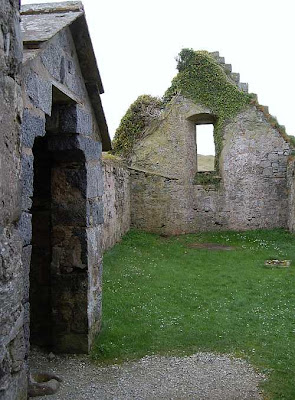

It is said that the clergy of the church had not wanted to bury such an evil man in sacred ground.

A compromise was reached, spurred on by payment (one source says it was his employer who paid, another says McMurdo himself prearranged his burial in the churchyard to guard against those who would desecrate his grave).

McMurdo’s grave was positioned “half in and half out” of the ground, protecting him within the church walls but leaving his eternal soul partially exposed, like a shiny thing for the eye of the Almighty.

During our wanderings we found some graves whose moss-covered skulls drew our attention far more than the desire for historical accuracy. For us, these rubbed-out and sinking monuments spoke more convincingly of a long-ago story of darkness, thievery, death and a timeless descent into spiritual rot.

Long before Balnakeil church, the first place of worship is thought to have been built some 1200 years ago (in Gaelic Balnakeil means “bay of the church”). The spot is also the final resting place of Gaelic poet Rob Dunn.

The church still looks out over to Balnakeil Bay, which leads to Faraid Head. It was there that an emigrant ship sank in 1849, killing all on board. Their bodies are housed in an unmarked mass grave, their combined bulk creating a small raised area in the south corner of the churchyard.
The whole scene is overlooked by the worn and stoic Balnakeil House. Built in 1744, it resembles a home from an atmospheric thriller, in which a harmless holiday to the seaside turns into something ghastly, as the walls begin to seep with the memories of past evil deeds. But perhaps it is just my imagination…

  © Blogger template 'Isolation' by Ourblogtemplates.com 2008

Back to TOP