Showing posts with label Historical figures. Show all posts

16 Jan 2011

Dreaming of spring in Rob Roy country

Thank you for the many kind suggestions on how to beat my winter blues. I am slowly starting to feel settled again, but one suggestion in particular has rooted itself in my mind. Wayne suggested posting some photos of Scotland in the spring, which is exactly what I have decided to do.

So let’s fast forward through the rest of the dark season and walk out into the new fresh world of spring, returning to Balquhidder Glen in time to see the daffodils blooming next to the gravestones in the churchyard.

This small churchyard is where Rob Roy is buried, along with this wife and two of his four sons. Their graves are alongside the gravel path and are surrounded by a metal rail with markers of their deaths (though I have read that the age of Rob Roy’s death shown on the marker is wrong, and that he died at the age of 63, not 70).

Rob Roy’s life has been extensively romanticised over the centuries, starting with his first appearance in Daniel Defoe’s “Highland Rogue” which led to a royal pardon for the famous cattle rustler. After his death, Sir Walter Scott’s novel “Rob Roy” brought the story to a wider audience, and Hollywood has gone on to cement his fame.
Compared to the rest of the churchyard, which contains the ruins of the original church and old gravestones surrounded by swathes of lush green grass, the burial site of the MacGregor family seems run down and somewhat sad.

If you are intrigued by the Rob Roy story, it is understandable you would want to see the place where he is buried. But I would encourage visitors to the Trossachs to avoid the trap of just stopping by the Balquhidder churchyard as a way to check something off a “to see” list. The experience of Rob Roy country (as the Trossachs are often called) is to be had by getting out in the countryside that MacGregor would have spent much of his life.
Even a short walk on the trail that leads off behind the church will get you beneath the trees with the sound of the river over rocks. Or if you have time you can create a more intimate holiday experience by walking the 79-mile Rob Roy Way.

This was just what I needed. I can look at these photos and almost believe that the next time I walk outside I will see the trees sporting swollen buds and be able to smell that sweet, new-life scent in the air.

If you could wake up anywhere in Scotland at the height of spring, where would you choose?

10 Jul 2010

A stroll through Alloway for Robert Burns lovers

Human creativity is a remarkable thing. It has the power to reinvent history, to layer a new story over old stones. If Robert Burns had never stood in the graveyard of Kirk Alloway and been inspired to write his famous poem Tam O’ Shanter, the spot would likely have been noted as nothing more than just another romantic site in Burns’ home town.

But he did stand here, and he was inspired. And from his mind he drew dancing witches, warlocks and even the devil himself.

He placed Tam at the edge of the scene, watching until he could not keep himself from calling out with passion for one of the witches. The fires suddenly extinguished and the witch Nannie took up the chase of a very humbled and frightened Tam.

Today this Kirk yard, which in the summer is beautifully adorned with dancing light and shadow thanks to the surrounding lushness of tall leafy trees, is one of the must-see locations for any Burns fan. His father is buried here, and although his mother's name is also marked on the stone, her body is buried in Bolton in West Lothian.
Just down the road, fans can also visit the very house where Burns was born, and where he lived until he was seven. The squat, white washed cottage features the thick walls and small windows that were standard at the time, practical for holding in heat.

None of the original furniture remains, however the rooms have been recreated to some extent, in order to help demonstrate the kind of life Burns’ family would have led.
The parlour is the most inviting room, with its fireplace, spinning wheel and nursing chair, as well as small embellishments like a wooden-handled paddle on the windowsill, an early tool for literacy instruction on which is written the alphabet and the Lord’s Prayer.

In one corner of the small room, hanging above a bed made of wood and a lumpy, straw-stuffed mattress, hang four small night gowns, lit up with white lights. Each night gown is embroidered with the name of one of the Burns children born in the cottage between 1759 and 1764. It is a silent, eerie sight, ghosts from childhood who can never leave the place they first came into the world.
When visiting Alloway it is impossible to miss the Burns Monument, a massive columned work that was built in 1820 and which is situated in the middle of a charming garden.

After that all the beautiful subtleties of the other Burns’ sites, this structure can seem a little brazen and out of place. Burns’ work was often so of the earth, paying homage to the average man of the fields, and the monument doesn’t quite match that tone.
There is so much to see around Alloway, including several other rural sites highlighted on this map from the Burns National Heritage Park.

In 2009, 250 years after Burns’ birth, The National Trust for Scotland began a major redevelopment of the park, which includes the building of a new museum, the Robert Burns Birthplace Museum.

No journey through Ayrshire can be complete without at least a short stop in Alloway. Not only can you spend many relaxed hours wandering a quaint and thoroughly beguiling village, but the magic of visiting an area of such vast cultural importance for Scotland is something that will stay with you for years to come.

23 Jun 2010

The elaborate sanctuary of Sir Walter Scott

“It may be pertinacity, but to my eye, these grey hills, and all this wild border country, have beauties peculiar to themselves. I like the very nakedness of the land; it has something bold, and stern, and solitary about it. When I have been for some time in the rich scenery about Edinburgh, which is like ornamented garden land, I begin to wish myself back again among my own honest grey hills; and if I did not see the heather at least once a year, I think I should die!”

        -Sir Walter Scott, as recorded by Washington Irving in 1817 (A Ramble with Sir Walter Scott).

It is 1832, and a team of horses is drawing a coffin containing the body of Sir Water Scott toward Dryburgh Abbey. They reach the crest of a hill, from which there is a commanding view over the surrounding countryside. Without prompting, the horses pause.

They pause because this is where Scott had always allowed them to stop and rest while he had gazed out over the hills and his beloved River Tweed. Such a simple moment, born out of routine, but a moment that provides an intimate glimpse into the depth of Scott’s attachment to the Scottish borders.

“Clausus tutus ero” is Latin for “I am safe when I am enclosed.” This is the motto of Abbotsford, Scott’s home and labour of love from the day he bought it in 1811 to the day he died, his bed having been moved into the dining room so he could look out over the Tweed and hear the sound of the water brushing the banks.

It is safe to say that there was no man as influential in establishing the story of Scotland than Walter Scott. Scott was a proud collector of artefacts that supported a romanticised image of Scotland and the “noble savages” of the Highlands. The entrance porch of Abbotsford House was built to resemble the one in Linlithgow Palace, while the ceiling in Scott’s library copies the one from Rosslyn Chapel.

Scott’s vast collection of beautiful items includes Napoleon’s pen case and a clock that is said to have belonged to Marie Antoinette. The armoury contains both Rob Roy’s broadsword and rifle, as well as his sporran.

On one wall hangs a set of dark, heavy keys that are reputedly from Loch Leven Castle, and in another room there is a lock of Prince Charlie’s hair. Sitting in Scott’s personal study, which contains the desk where he did much of his writing, is the Robroyston chair, made from the roof timber of the building in which William Wallace was betrayed and captured.

Not all of the items Scott collected belonged to famous people. One of the most remarkable items on display at Abbotsford is a small crumbling piece of oatcake, drawn from the sporran of a Highlander who was killed at the battle of Culloden.
When the stock exchange in London crashed in December of 1825, Scott, who had been one of the wealthiest writers who had ever lived, was suddenly plunged into a quagmire of debt.

Not wishing to give up his home, Scott struck a deal to write himself out of debt. Thus began six years of relentless creative output, during which time he earned great sums to appease his creditors but which in the end also caused the decline of his health and ultimately led to his death at the age of 61.

Today the estate is run by The Abbotsford Trust. Along with keeping the grounds immaculately groomed and preserving the many historical artefacts, the trust diligently maintains the ambience of the home as Scott would have designed it. For example, the 9,000 books in the library are arranged in the order that Scott left them more than 170 years ago.
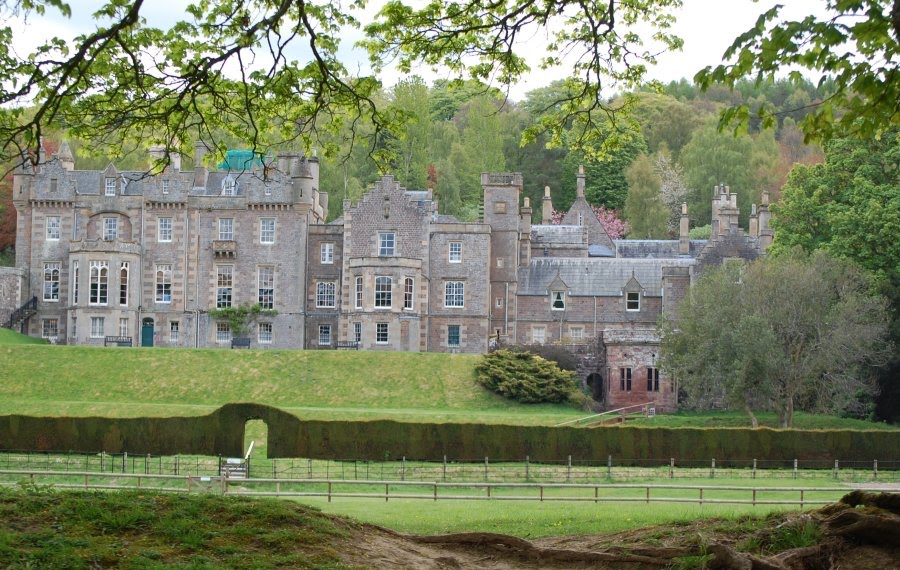
Abbotsford House is a love letter to Scotland built from stone. So much of Scott’s passion for Scotland and especially the borders, went into the decoration of the rooms and the display of his many historical treasures. As a visitor, it is impossible to stand in the dining room and look out at the same view that Scott would have seen during his final days, and not feel surrounded by his great adoration for this place.
Take your time when you visit. Take time especially to walk down to the river and just sit and watch the water, listen to the gentle hiss and burble of it over rocks and earth. When you turn you will see the tree branches framing your view of Abbotsford House, which stands steadfast and lonely, as if it has been waiting all these years for him to come home.
*All photos included of the interior of Abbotsford House have been graciously provided by the Abbotsford Trust. Click here to visit the official Web site of Abbotsford House.

13 Dec 2009

A sunshine view of Greenock


In Scotland, a day without rain or the threat of rain is valuable. It is an increment of time in which the light is not diffused, but skidding around objects and casting shadows like they were puppets. I have long since learned that a morning that involves the promise of a blue sky is one to be cherished.

It was on such a clear and cold morning that I recently found myself in Greenock. Well, I didn’t exactly find myself there - I went there on purpose. But perhaps it was meant to be, as I have just discovered that Greenock is said to come from the Gaelic Grianaig, which means “a sunny place.”

My beloved has few glowing remarks to share about his hometown. True, this traditional ship building port can be seen as just another bead on the urban necklace that stretches from Glasgow westward along the River Clyde. And no doubt it would look a far grander place today if so much of it hadn’t been flattened in a two-night blitz during WWII. But on a clear day it is easy to discover the things that made this town so prosperous during its heyday in the shipping industry.

The waterfront that runs along next to the domineering 1818 Custom House is quiet and quaint and offers lovely views across the river as it swells into the Firth of Clyde. I was there on a weekend and wasn’t able to see the museum that is currently run in the Custom House. (I had better get there soon as it is scheduled to be closed in 2011).


Up the hill, Greenock’s war memorial is beautiful. Of course JP would tell you not to spend much time in the surrounding park in the evenings, but on a bright morning it shines with its intended purpose. Behind it Victoria Tower is easily viewed. In fact the 245-foot tower, part of the municipal building, can be seen from almost anywhere in town, a helpful landmark for visitors and folks on their way home after having one too many at the pub.

There is much to see in Greenock if you just look up. The carvings in the area around the municipal building are ornate and stunning. Gods and goddesses swathed in robes and garlands can be seen looming wisely or driving their chariots around the walls of practical industry. Even the Sheriff’s Courthouse looks like it has been transplanted by Disney. (You’ve been found guilty! Now the Sentencing Fairy will sprinkle you with the Dust of Repentance and lead you over the Bridge of TskTsk and out into the Lake of Reflection, where you will spend the next 20 days on the Isle of Gloom).


The name James Watt is everywhere around town, including a museum, a college and even a pub. An inventor and engineer, Watt’s improvements to the steam engine changed the world by giving the industrial revolution a swift kick up the backside. Say hello to Mr. Watt himself in front of the - what else- James Watt Building:


This is certainly a place to go if you like to go to church. The first church was established here in the late 1500s and today there are churches all over Greenock. There is even a church in the mall.

I suppose the best thing about Greenock is its central location, not only to Glasgow but to numerous other small towns and historical sights and of course ferry terminals. I am already counting down to spring so we can go to Wemyss Bay and take the ferry to Rothesay on the Isle of Bute (not that we couldn't go now, but I am waiting for this place to open).

Perhaps it is impractical to write about a place that is - unless you’re an engineering buff - several miles off the standard tourist trail. But when I ask myself “was it pleasing to my senses?” I have to answer “yes.” In which case, it is worth sharing.


  © Blogger template 'Isolation' by Ourblogtemplates.com 2008

Back to TOP