Showing posts with label ayrshire and arran. Show all posts

10 Jul 2010

A stroll through Alloway for Robert Burns lovers

Human creativity is a remarkable thing. It has the power to reinvent history, to layer a new story over old stones. If Robert Burns had never stood in the graveyard of Kirk Alloway and been inspired to write his famous poem Tam O’ Shanter, the spot would likely have been noted as nothing more than just another romantic site in Burns’ home town.

But he did stand here, and he was inspired. And from his mind he drew dancing witches, warlocks and even the devil himself.

He placed Tam at the edge of the scene, watching until he could not keep himself from calling out with passion for one of the witches. The fires suddenly extinguished and the witch Nannie took up the chase of a very humbled and frightened Tam.

Today this Kirk yard, which in the summer is beautifully adorned with dancing light and shadow thanks to the surrounding lushness of tall leafy trees, is one of the must-see locations for any Burns fan. His father is buried here, and although his mother's name is also marked on the stone, her body is buried in Bolton in West Lothian.
Just down the road, fans can also visit the very house where Burns was born, and where he lived until he was seven. The squat, white washed cottage features the thick walls and small windows that were standard at the time, practical for holding in heat.

None of the original furniture remains, however the rooms have been recreated to some extent, in order to help demonstrate the kind of life Burns’ family would have led.
The parlour is the most inviting room, with its fireplace, spinning wheel and nursing chair, as well as small embellishments like a wooden-handled paddle on the windowsill, an early tool for literacy instruction on which is written the alphabet and the Lord’s Prayer.

In one corner of the small room, hanging above a bed made of wood and a lumpy, straw-stuffed mattress, hang four small night gowns, lit up with white lights. Each night gown is embroidered with the name of one of the Burns children born in the cottage between 1759 and 1764. It is a silent, eerie sight, ghosts from childhood who can never leave the place they first came into the world.
When visiting Alloway it is impossible to miss the Burns Monument, a massive columned work that was built in 1820 and which is situated in the middle of a charming garden.

After that all the beautiful subtleties of the other Burns’ sites, this structure can seem a little brazen and out of place. Burns’ work was often so of the earth, paying homage to the average man of the fields, and the monument doesn’t quite match that tone.
There is so much to see around Alloway, including several other rural sites highlighted on this map from the Burns National Heritage Park.

In 2009, 250 years after Burns’ birth, The National Trust for Scotland began a major redevelopment of the park, which includes the building of a new museum, the Robert Burns Birthplace Museum.

No journey through Ayrshire can be complete without at least a short stop in Alloway. Not only can you spend many relaxed hours wandering a quaint and thoroughly beguiling village, but the magic of visiting an area of such vast cultural importance for Scotland is something that will stay with you for years to come.

29 Jun 2010

Tam O' Shanter and The Brig O' Doon

You have to imagine it in the dead of night, the curve of the stone steady above the moving water, which unlaces the reflected shards of moonlight until they swim like the ghosts of fish. Blink once and they will be gone, blink again and a new school will have formed just a few feet away, swirling and diving, wild and joyful in the impossibility of their ever being caught.

Now hear the clop of the horse's hooves on the cobbles, the rattle of the bit in her mouth. See her hide shudder and the steam rise off her, and smell the combined waft of earth, hay, sweat and fear. Hear the manic cackle of a blood-thirsty witch, and see the bewildered look on the horse’s intoxicated rider, Tam O’ Shanter.

Heading home after a night of drink and debauchery, Tam is pursued by Nannie the witch. Tam and his trusty mare, Maggie, must reach the bridge’s peak, the point that marks the official crossing from one side of the river to the other. For it is widely know that witches and other evil spirits cannot follow their would-be victims past the middle of a running stream.

Of course they do make it, but not before poor Maggie loses some tail hairs to Nannie’s lunging grip.
There is such deep pleasure in being able to visit the very places that inspired some of Robert Burns’ greatest works. Located in the Alloway in Aryshire, where Burns was born, the famous Brig O’ Doon is such a romantic sight that it looks like something Burns drew from his mind and placed there in order to add drama to his tale.

I love Alloway so much that I am splitting my adventures there into more than one post. Thanks to Tam O Shanter, The Brig O’ Doon will never be seen as just another stone bridge. A little bit of magic happened here, and you cannot visit without walking up over the peak yourself, until you are across the water and safe from the spirits who might seek to follow you and do you harm.

If you are not content to see the bridge only by day, there is always the option of treating yourself to a stay at the stunning Brig O' Doon House Hotel, which is just up the road from the bridge. Then you really can go out by moonlight, look down at the rushing water, and play the story of Tam O’ Shanter over in your mind.
Ah, Tam! Ah, Tam! thou'll get thy fairin!
In hell, they'll roast thee like a herrin!
In vain thy Kate awaits thy comin!
Kate soon will be a woefu' woman!
Now, do thy speedy-utmost, Meg,
And win the key-stone o' the brig;
There, at them thou thy tail may toss,
A running stream they dare na cross.
But ere the keystane she could make,
The fient a tail she had to shake!
For Nannie, far before the rest,
Hard upon noble Maggie prest,
And flew at Tam wi' furious ettle;
But little wist she Maggie's mettle!
Ae spring brought off her master hale,
But left behind her ain grey tail:
The carlin claught her by the rump,
And left poor Maggie scarce a stump.

Now, wha this tale o' truth shall read,
Ilk man and mother's son, take heed:
Whene'er to Drink you are inclin'd,
Or Cutty-sarks rin in your mind,
Think ye may buy the joys o'er dear;
Remember Tam o' Shanter's mare.

21 Jun 2010

Happy happy solstice


Do you remember a few weeks ago I wrote that within a month the flowers and plants that line the paths through the walled gardens at Culzean Castle would be waist high?

It is true. This is how the gardens look at high summer. A big solstice squeeze for lovers of beautiful Scotland. Have a wonderful day.

5 Jun 2010

Welcoming summer at Culzean Castle

If there is a place to well and truly welcome summer into your life, the 600 acres of manicured splendour that surrounds Culzean Castle is enough to make you babble deliriously at the bees.

I achieved just such a state of dreamy awe during our most recent visit. Imagine me, half strolling and half gliding across the lawns in front of the tiered gardens and the light caramel exterior of the castle itself.
“Hello fountain…hello palm trees…hello lovely giant stone planter filled with perky yellow flowers.” Every few minutes I lower my camera and grin dopily over at JP, who shakes his head and tries to keep me moving before all my limbs turn to rubber and I collapse.

All of this before we take the stairs that lead down to the banks of the Forth of Clyde. From here it is easy to get a sense of what an imposing sight this estate would have been several hundred years ago, gleaming from its cliff top, a delicate gem and a impenetrable fortress rolled into one.
It is low tide so we take our time walking around rocks and boulders, staring into pools and even turning over a couple of stones to see if there are any wee beasties hiding there. A blood red sea anemone gleams in the water, its tentacles waving lazily in the tiny current as the tide begins to push back in.
With the rare treat of a cloudless Scottish sky calling us to remain outside, we take only a quick tour of the Castle’s interior before heading back out. The history of Culzean is tied to the Kennedy family, who trace their ancestry back to Robert the Bruce.
There are two elements of the castle interior that I adore above all, and since no photos are allowed inside, I share two that I have borrowed from the property’s web site.

The red and white flourishes of the oval staircase makes you feel like you're walking up the swirling insides of a Willy Wonka candy, only to emerge into the ultimate sugary centre, the round drawing room.

This room was used for entertaining and was usually kept sparsely furnished. After all, who would want to risk adding anything that might detract from the gasp-inducing sea views available out of each and every window.
As stunning as the interior of the castle is, on the cusp of summer there is nothing that compares to the lush beauty of the larger estate, from the gardens to the forest walks and the wide blue belly of the Forth of Clyde.

Everywhere we turn, scenes of idyllic grandeur fold open like a living pop up book. The sunlight pushes through the trees, causing the already intense green to glow even brighter.
Within a month the plants that line the main path through the walled gardens will be waist high, but for now the last of the apple blossoms are slowly fading, the breeze plucking some off their branches and sweeping them down on us as we walk. How can anything be this romantic? Jane Austen would have swooned. Even the estate’s deer seem amazed by it all.
Today we have just the swan pond (which today holds only ducks) and the pagoda left to see. The pagoda has been rebuilt in the same design as the original. Back in the 1800s it housed exotic birds and animals, and as it is set on a hill and surrounded by tall trees, I can’t help thinking it would make a dream fort for children (or an ideal escape nook for adults).

This was my second visit to Culzean and I am more in love with it than ever. A property like this calls for some additional planning in order to get the most of it:

-Come early. Culzean is one of Ayrshire’s most popular tourist destinations, including tour buses and school outings. Arriving when the grounds open gives you the best opportunity to bask in a bit of solitude. Also, on days that start out sunny, clouds can often start to sweep in by 11am, so an early start could mean more blue sky views.

-Give yourself the whole day. It’s 600 acres, remember? If you don’t have a picnic lunch along, go to the café and eat chocolate cake while overlooking the Ayrshire coastline.

Thus ends our summertime tour of Culzean. I can’t believe it’s over. Sigh.

Wait - shall we go again? Why not. Here’s a lovely forest path, with the sun shining through just so. Let’s see where it takes us, shall we?

3 Jun 2010

A ruin with a view: Dunure Castle

Scotland can sometimes make you feel like you have landed inside a postcard. You can stand there and not know whether you are moving inside this world or whether it has wrapped itself around you like a collective memory, a perfect, solidified expression of beauty.

Just like that, you have popped up here in the southwest of Scotland on the Firth of Clyde. A wide green lawn drapes down the hill towards Dunure Castle, which kisses the jagged edges of the Ayrshire shoreline. The dark cliff stones seem to creep upwards over the castle’s crumbling foundations, a jawline set against the tide of imminent destruction by the elements.

On a calm summer day the sounds are simple ones. The bees scour the patches of scotch bloom that are bursting with the crayon yellow we used to paint the sun as children. The waves are so lazy they barely lap over the rocks below, and in the shallows an occasional bird can be seen poking around the kelp for snacks. In the distance the island of Ailsa Craig looms like a muffin top above the water.
I imagine a storm would have been blowing through a soup of complete blackness on the night Gilbert Kennedy roasted Alan Stewart on a spit over the kitchen fires. Dunure’s history is long and varied but it is this story that sticks with people when they hear it, and how could it not?

What a scene it would have made: behind the thick stone walls of a castle perched above the water, a wealthy landowner from a prominent family uses his cruel imagination to coax an agreement from an abbot of a nearby abbey into signing over the rights to the abbey lands.
Much of the castle is closed off now, thought to be too dangerous to wander around. There are still some areas open to see, but up close much of the building’s drama is lost. It is only when you step back and see it in its glorious, wild surroundings that Dunure becomes a place to remember.

The dovecot is the same. Inside it is littered with sweet wrappers and juice bottles, not to mention the pungent scent of bird droppings that plumes out at you when lean in for a closer look. But if you move back just a little and look again, you will see it slot into the wide-screen vision of history, sea and sky.
The stone maze is a new addition, built by volunteers with the aim of adding to the ambience of the place. I still haven’t decided whether it has worked. This spot is already surreal and inviting - did it need anything else?
Granted, I don’t know how many visitors make the commitment to venture off the main road that leads to Ayr, and venture down into Dunure. It can be difficult for small villages to lure people to their beauty spots, when they are surrounded by bigger, bolder sights nearby.

But it is this edge of isolation that also makes Dunure Castle special. This is just the kind of thing people comes to Scotland to see: nature curled up against history, a genteel flourish in the midst of an otherwise unforgiving landscape. Like stepping into a postcard.

What places in Scotland give you that “postcard” feeling?
***********************************************
I had a wonderful surprise today - a visit by two fellow bloggers! The lovely Canadian Ms Toastburner of One Slice at a Time, and the incomparable Neil Tasker of the Scotland blog Light and Dark were in Edinburgh today and popped by to say hello. Ms Toastburner even brought me treats from Canada in the form of Kraft Dinner and Shake ‘n Bake! It made my day. Hooray for blog friends!

7 Apr 2010

Escape to the Isle of Cumbrae

Let’s just go. We could. The ferry is here, waiting for us. To cross the water from Largs takes just ten minutes. We could go.

Let’s not take the car. What’s the point? The island is only four miles long, and everything we’ve read tells us the best way to travel here is on foot or by bicycle. I can feel myself slowing down already, can you?

If you don’t want to walk into Millport Bay we can dig out change for the bus and just relax. On a sun-drenched day like today it is like stepping out into a postcard.

Sheltered from the wind, a quaint harbour with bobbing boats, a sandy beach, and children clamouring over rocks between bites of picnic lunches and bouts of crazy golf. In the distance the mountains of Arran loom down, later oozing through the haze of the afternoon, when the evaporating tide creates a sheen on the beach.
We can walk up and down the main street, trying to decide what to have for lunch and watching the gulls fight for scraps of hotdog buns or stolen chips.

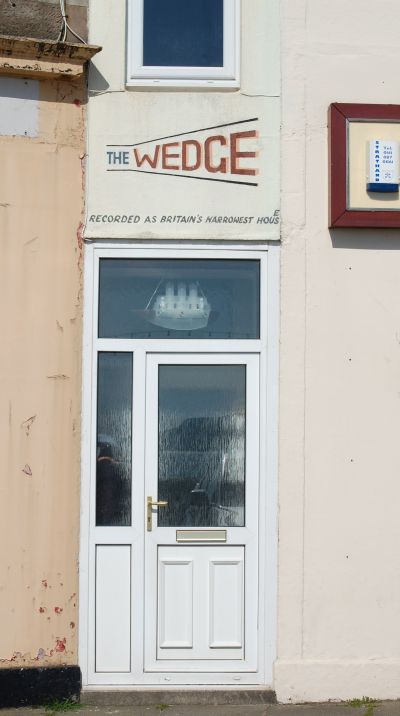
Sure, we may have to ask three times for directions to the location of Britain’s Narrowest House, only to realize later we had walked right past it. But it’s not like we’re in a rush.

We can stand in front of it, wondering at its Roald Dahl squishiness, like it is a younger brother trying to squeeze between his larger siblings for a photo.
After lunch we can sit for awhile on crocodile rock and watch the sailboats sweep past in the distance. Then I’ll ask you to take a hike with me, to the top of one of the hills so we can look out over the whole world which is this tiny island.

Vikings stayed here once, did you know that? After snatching the Hebrides back from Alexander III of Scotland, King Håkon (they called him Haakon the Old) launched his attack on Largs as he tried to keep control of Norway’s medieval kingdom. Alas it was no good, and eventually his great leidang fleet was driven back to Orkney, where Håkon died on 16 December, 1263.
Once we have walked and eaten and heaved ourselves up tall hills and watched the sailboats and played the crazy golf and sworn at the gulls and just sat, looking and not thinking at all, we can turn around and go home again. We can hop the bus and clamour back onto the ferry, stand on the deck and watch the harbour at Largs grow large on the horizon.

We could go. Do you want to?

  © Blogger template 'Isolation' by Ourblogtemplates.com 2008

Back to TOP