Showing posts with label forests and parks. Show all posts

30 Apr 2011

Isle of May: Highlights

The Isle of May will make you think of Arthur Conan Doyle’s Lost World. On the island’s western side, sheer cliffs reach up from the waters of the Firth of Forth. Noisy guillimots - around 30,000 of them - clutter every available rocky ledge, while thousands of kittiwakes dive and squawk in what seems to be a mad, confused display.

If you are prone to seasickness and the water is choppy, you will not enjoy the more than 45-minute journey to the island. As eager as you will be to take it all in as you approach, all you will be able to do is look towards the horizon and focus on your breathing.

Once your shaky legs touch solid ground again, you look up to see your first puffin, sitting at a distance atop a concrete outbuilding. Today the Isle of May is inhabited each summer season by a handful of researchers from Scottish Natural Trust, but over the centuries it has been a holy retreat for monks, a village for fishermen and their families, the site of Scotland’s first permanent lighthouse, and a wartime lookout post.
You have two hours to follow the paths around the two-kilometre long island. If you thought you were excited about seeing one puffin, prepare to fall utterly in love with these tiny clown-faced birds. From just 10 pairs in 1950, the Isle of May is now home to the largest breeding colony of puffins in the UK.

As tempted as you may be to leave to path to get closer, don’t! You could disturb a puffin burrow or the nest of a female eider duck, who, unlike the drake with his stark black and white plumage, blends in neatly among the tufts of uneven grass.
There will be so much going on around you that you won’t know where to look. These seabirds descend en masse to breed and raise their young, rattling every fibre of life while there is time.

If you are lucky, you will spot some grey seals sunning themselves on the beach on the west side of the island, or poking their heads out of the water. In the autumn the birds will return to the sea as the seals come ashore to welcome another 2,000 pups into the world.
It will be difficult to leave, and not just because you are dreading a second bout of illness on the way back to Anstruther. What is most precious is being a passive observer among creatures who are so oblivious to you.

You are a curious two-legged thing that walks by and will not harm them. When you leave you will not be remembered. But you will remember them and be grateful for all the rapturous life that will continue when you are gone.

The journey back is fine, since you head straight to the upper deck and an endless supply of cold, fresh air. Yes, your bones will feel as if they have atrophied by the time you enter Anstruther harbour, but it will be worth it.

If you want to learn more about the Isle of May, Scottish Natural Heritage offers a great virtual tour.
On a side note, the Isle of May is a wonderful place to get engaged.

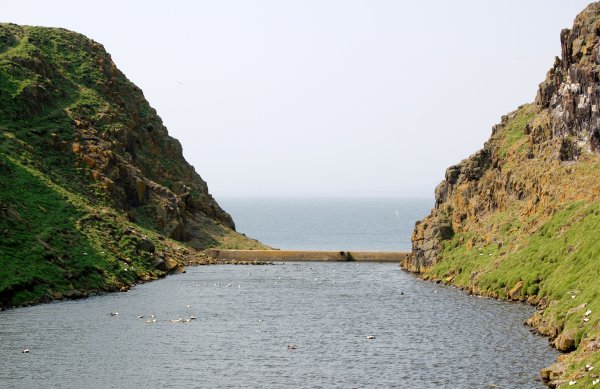
Particularly if you are looking out at a view like this one.

Happy Beltane, everyone!

12 Apr 2011

Welcome to Romantic Roslin Glen

Hello you. Welcome to the two year anniversary of this wee blog dedicated to the sensual pleasures of Scotland.

For me it would not be a celebration unless I indulged in some kind of enjoyable excess, so I invite you to the following photo heavy tribute to the many beauties of Roslin Glen and the River North Esk.

The splendour begins not long after we leave the village of Roslin, the name for which is formed of two Celtic words, Ross - a rocky outcrop and Linn - a waterfall.

Looking now through all the layers of springtime green, it is difficult to imagine a time when these fields would have been stained with blood. On February 24 1303, Scottish and English forces clashed here for the 3rd battle of Roslin, an event when saw a Scottish victory but also horrendous casualties.
Today the sun is out and as we meander the path between fields and forest we think “this is nice,” because it is. Open space, clear air - a pleasant country walk.

But when we take the turn to follow the river walk, everything changes. Suddenly get a view of the valley that stops us in awe because we didn’t expect this kind of romantic scene.

Once we can move again we thump down worn stone steps, stopping half way to follow a butterfly from blossom to blossom with our camera.

Our route, referred to in the guidebook as The Riddle of Roslin, directs us along the river trail, but it is impossible to resist a detour to see the remains of what the local information boards call Maiden Castle.

It is thought that sometime during the late bronze age and the iron age, between 1000 BCE and 200 AD, this ridge above the river was home to a large family group. This was not a castle as we might think of it, but simple roundhouses and some minor defences of stone banks and deep ditches. With the surrounding forests and the fish-rich river for food, a family could have thrived here.
Today, if it weren’t for the information boards to advise us of the history of this place, we would walk unaware through the ghosts of our bronze age ancestors. We are always trying to revive our pasts, while nature feels no such need to cling. She moves on, grows over, lives today.

Finally we begin to explore the banks of the river, which are bulging with green and fresh stems and the pristine white petals of wood sorrel.

The river is high and slow from spring rains and moves gently past banks that are so thick with plants it is as if life is something that can be purged in one great heave.
Nearby old trees take a humble back seat to all the countless new shoots. They allow the wind to stir their branches, whisks inside an infinite bowl. At the water’s edge their roots wrap like fat baby knuckles around plates of ancient glacier stone.

I tell you, there is no way to photograph all of this. Everywhere around us, birdsong bounces back and forth like a room full of grandfather clocks, time reduced to a ball that no one can catch.
We walk for a long time, trying to follow the book but often veering onto this path or that, just letting ourselves wander, to spread out and discover.

Like when we come to he place where rust-coloured rocks overhang the trail and remind us of scenes of the grand canyon. High above us we can see small caves and we long to look in.
This desire intensifies a short while later when we look across the river to see Wallace’s Cave, named for Scotland’s national hero, who took part in the Battle of Roslin.

With no way to get to the other side and explore, we will have to make do with this video from BreatheScotland.

The cave is also associated with Hawthornden Castle, which stands across the river, somewhere beyond the clutter of tree branches.

Hawthornden Castle was built in 1638 by poet William Drummond. A little research has brought me to the brink of jealous delirium as I have learned that part of the castle is now used as a retreat for writers and artists.

Each year the Hawthornden Castle Fellowship offers five writers a place here for a month of seclusion. It’s alright if you need a moment to let the idea sink in. We have time.

Somehow we are nearing the end of our walk. Already? Well believe it or not, we have been away for hours.
We’ve taken so many detours and stopped so many times to try and memorise the exact undertone of sweetness in the air, that by the time we have journeyed through the last of the forest trails and are making our way up the stairs and through the archway leading to Rosslyn Castle, we are well and truly knackered.

The castle was built after the battle of Roslin, but much of it was destroyed by fire in 1447. The only part that is still inhabitable is the five storey house that was built as part of later restorations. If you are feeling particularly burdened by cash, you can even stay here.
For the moment let’s set aside plans to visit the famous wee Rosslyn Chapel. We’ll wait until the construction work for the new visitor’s entrance is finished, and hope that visitors will once again be able to at least get close to the outside of the chapel without having to shell out the £7.70 entrance fee.

Thank you for reading. Over the past two years I have so enjoyed sharing my  adventures on this wee patch of the internet. I enjoy all manner of enthusiasm and supportive comments. You are welcome for cake anytime. Let’s have a seat just here and enjoy a bit of sun, shall we?

20 Mar 2011

On the road to Duddingston

Blogging can often surprise you, taking you on adventures you had never expected. It’s especially rewarding when you get the chance to meet and even work with folks you admire.

I’ve long been a fan of the Pocket Mountains books, a series of handy wee guides to Scotland comprised mostly of town and country walks in various areas of the country.

The publishers are aiming to refresh their Edinburgh edition next year, so I’m going to be doing the walks, making notes and just ensuring the routes are still open and clear. Of course, if I have to go on 40 town and country walks, you’re all coming with me.

Our first foray is walk #14, “Radical Road from Duddingston,” which starts at the foot of the hills in Holyrood Park.

Our route is a combination of trails through the park and pavement along Queen’s Drive, while taking in grand views of the sombre Arthur’s Seat and the platform-like Salisbury Crags.

Our half-way point and the highlight of the trip is the quaint village of Duddingston, home of Scotland’s oldest surviving public house.

The welcome glow of green is starting to show through on the hills, and on the trees the buds seem to be desperate to burst. All the same, the long descent into Duddingston brings a welcome break from the sometimes chilly wind that continues to whip over the open areas.

The first thing that is likely to draw a visitor upon entering Duddingston is the Kirk, which sits on a high slope overlooking Duddingston Loch. Founded in the 12th century by a Norman knight, it has undergone a number of changes over the centuries.

This included the addition of a separate gatehouse meant to keep out 19th century body snatchers, who were intent on selling fresh corpses for medical research.
Still attached to the stone wall outside the Kirk are “jougs” or stocks, where criminals suffered the punishment of being held by an iron collar, on display for all the faithful to see.

If you’re like me you’ll wander the yard at least once, looking for unique gravestones. Against one wall, a small Celtic cross bears a sad, simple proclamation in memory of “Wee Jim.”

Leave the Kirk to take a stroll down to Duddingston Loch and try to imagine the Reverend Walker, balanced and stoic on his skates in what has become one of Scotland’s most famous paintings.
Finally, I think we’ve earned the right to hoist a pint in the spot which has been home to a pub since 1360. We’re off to The Sheep Heid Inn. The story goes that King James IV of Scotland gave the innkeeper an ornate ram’s head snuff box in 1580, giving the inn its name.

The light was too dim for indoor photos, so you will just have to imagine the dark wood, the low, heavy-beamed ceiling and the walls cluttered with old clocks all stopped at different times, brass pots and pans, and of course, a collection of mounted sheep heads.
For those with a love of the macabre, take yourself back to 1724. You’re tucked in at a table at the busy inn, where a fire is roaring and a closed coffin is on display. This is the funeral of Maggie Dickson, who has just been hung for infanticide.

As you sit nursing your drink, the room goes silent as banging and scratching sounds start to come from inside the coffin. The lid is lifted and Maggie is found still alive. She goes on to make a complete recovery and becomes known as “Half-Hangit Maggie.”

The downside to surviving her hanging? Since she had been pronounced dead, she had to remarry her “widower” husband.

We both loved The Sheep Heid Inn. This is one of the best things about Scotland -these small local places which have been central to village life for centuries. This is the kind of place that can change a visit to Edinburgh from simply pleasant to truly memorable.
Now that you’re sloshing with food and drink, you’ll have to haul yourself uphill over The Radical Road, a stony path built by unemployed weavers in the 1820s. The project was made at the suggestion of none other than Sir Walter Scott, and the reward for putting one foot in front of the other are the magnificent views of Edinburgh Castle and an opportunity to get up-close to the unique geological features of Salisbury Crags.
Overall, I thought this walk was excellent. Keep in mind the trails can sometimes be muddy and I would caution those with bad knees that the final descent down Salisbury Crags can be a bit sore. However, for ease of access from the city centre to the variety of natural and historical features, I would give this an enthusiastic 9/10.

Only 39 walks to go!

**************
Blog news: Some of you may have noticed the addition of a wee donate button in the sidebar of this blog. For the past two years I have kept this blog advert free, but this is something I am currently considering to help keep me going on these adventures that I love. “The bacon buttie fund,” as I have named it, is there to give people the opportunity to support me if they value the work I am doing.

Thanks again for reading. Squeeze.

  © Blogger template 'Isolation' by Ourblogtemplates.com 2008

Back to TOP