Showing posts with label wildlife. Show all posts

30 Apr 2011

Isle of May: Highlights

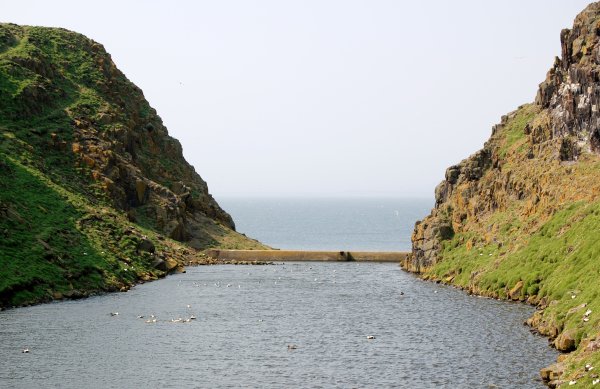
The Isle of May will make you think of Arthur Conan Doyle’s Lost World. On the island’s western side, sheer cliffs reach up from the waters of the Firth of Forth. Noisy guillimots - around 30,000 of them - clutter every available rocky ledge, while thousands of kittiwakes dive and squawk in what seems to be a mad, confused display.

If you are prone to seasickness and the water is choppy, you will not enjoy the more than 45-minute journey to the island. As eager as you will be to take it all in as you approach, all you will be able to do is look towards the horizon and focus on your breathing.

Once your shaky legs touch solid ground again, you look up to see your first puffin, sitting at a distance atop a concrete outbuilding. Today the Isle of May is inhabited each summer season by a handful of researchers from Scottish Natural Trust, but over the centuries it has been a holy retreat for monks, a village for fishermen and their families, the site of Scotland’s first permanent lighthouse, and a wartime lookout post.
You have two hours to follow the paths around the two-kilometre long island. If you thought you were excited about seeing one puffin, prepare to fall utterly in love with these tiny clown-faced birds. From just 10 pairs in 1950, the Isle of May is now home to the largest breeding colony of puffins in the UK.

As tempted as you may be to leave to path to get closer, don’t! You could disturb a puffin burrow or the nest of a female eider duck, who, unlike the drake with his stark black and white plumage, blends in neatly among the tufts of uneven grass.
There will be so much going on around you that you won’t know where to look. These seabirds descend en masse to breed and raise their young, rattling every fibre of life while there is time.

If you are lucky, you will spot some grey seals sunning themselves on the beach on the west side of the island, or poking their heads out of the water. In the autumn the birds will return to the sea as the seals come ashore to welcome another 2,000 pups into the world.
It will be difficult to leave, and not just because you are dreading a second bout of illness on the way back to Anstruther. What is most precious is being a passive observer among creatures who are so oblivious to you.

You are a curious two-legged thing that walks by and will not harm them. When you leave you will not be remembered. But you will remember them and be grateful for all the rapturous life that will continue when you are gone.

The journey back is fine, since you head straight to the upper deck and an endless supply of cold, fresh air. Yes, your bones will feel as if they have atrophied by the time you enter Anstruther harbour, but it will be worth it.

If you want to learn more about the Isle of May, Scottish Natural Heritage offers a great virtual tour.
On a side note, the Isle of May is a wonderful place to get engaged.

Particularly if you are looking out at a view like this one.

Happy Beltane, everyone!

25 May 2010

A seal-less visit to Tentsmuir Point

Do you ever have adventures that at the time seem like a terrible punishment but somehow, days or weeks later, your mind romanticizes your memories and causes you to smile and sigh while looking through your photographs?

I know with certainty that my beloved will mock me, but suddenly I’m feeling all dreamy about Tentsmuir Nature Reserve. Of course, he is right to mock me. After all, all the material we had read before visiting Tentsmuir Point had waxed lyrical about the Tay estuary’s “year-round” seal population.

We walked and walked, taking the forest path and entertaining ourselves with banter of outlandish fictions about evil happenings in the woods, before launching into a contest to see who could find the biggest pine cone (I won).

Finally we turned and saw the sign that signalled we would soon be emerging onto the beach. The information board advised us to be aware of the possibility of Highland Cows grazing near the dunes (we didn’t see any).

Also, to illustrate a message about how dog poo poses disease risks for local wildlife, the sign boasts a charming cartoon of a squirrel being sick into a paper bag.
We crested a small dune and stepped onto the beach. And what a beach it was. It was vast and almost vacant, the beige sand stretching out to a blue-grey skyline of high cloud. The view was like a film that had been leached of colour, an eerie apocalyptic scene that made me think of The Waste Land:

The river's tent is broken: the last fingers of leaf
Clutch and sink into the wet bank. The wind
Crosses the brown land, unheard. The nymphs are departed.
Sweet Thames, run softly, till I end my song.
The river bears no empty bottles, sandwich papers,
Silk handkerchiefs, cardboard boxes, cigarette ends
Or other testimony of summer nights. The nymphs are departed.
Of course, this place is not lifeless. The Tay is a valuable habitat for waterfowl, including the UK’s largest winter gathering of eider ducks. But this was not winter, and we were not here to see ducks. We wanted to see seals.

On and on we walked, our shoes sinking into the soft sand while the grass danced on the dunes beside us. We thought that after the next curve…the next one…that perhaps we would see the tell-tale black tube of a seal on the beach. But there was nothing.

Eventually we gave up, turned inland again and past the long rows of 1941 anti-tank blocks, which stand like massive forgotten dominos along what used to be the high tide line (the sands here are always moving, carved out by the sea on the south side and dumped on the ever growing north beaches).
Perhaps it is because my work is becoming busier as we head towards the festival season. Everyday when I walk to the office I can feel Edinburgh shifting gears, preparing. Whatever the reason, now when I look at these photos I find myself longing for the wild unbroken vista of beach, sea and sky. The landscape stretches in a way that I cannot.

In conclusion, I shall let Tentsmuir Point be a lesson in expectation. If you rely too heavily on one idea, you risk not being able to fully appreciate the beautiful alternatives that await you should that initial desire not unfold.
Thanks for visiting this wee patch of Scotland-loving Internet. This blog is an expression of my relentless curiosity and love for this country, and I am so grateful for all the kindness and enthusiasm my readers have shown to me.

Another thank you to those who have been joining in my tea giveaway. I love reading all your comments and stories about the part tea plays in your lives. The door for entries will remain open until Saturday and I’ll draw names on Sunday. Please visit the May 23 Scottish Breakfast Tea post to enter.

15 May 2010

The timber ponds of the River Clyde

Hello you. It’s a beautiful day. Let’s go for a walk.

We can leave Newark Castle behind and follow the River Clyde towards the old timber ponds. These are vestiges of the area’s 18th century shipbuilding boom, when tens of thousands of tons of wood were hauled across the sea from North America before being stored in massive log corrals.

You can imagine logs of yellow pine, pitch pine and oak, looking almost romantic as they floated in their watery cages, waiting to be chosen for a  ship’s hull or bit of decking.

But when the storms hit the logs could break their shackles, floating out to block the river and bringing commerce to a halt until they could be rounded up again.

The timber ponds fell into disuse in the early 19th century and since then nature has been reclaiming the gnarled and kelp-covered posts, wearing them away and drawing them slowly downwards. There is something  beautifully macabre about them, like last-gasp limbs reaching up through their mudflat graves.

On and on they go for more than three miles, a cemetery of industry that has been taken over by wildlife.
The area is now a nature reserve and best time to experience it is in the winter, when thousands of waterfowl and waders make the mudflats ripple with life.

But even now as the days stretch slowly into summer, there are pockets of redshanks still puttering in the shallows, crows perched here and there like inky beacons, and even sometimes a heron strolling calmly through the water like a benevolent stalker.
Walking along, the sense of space and peace is precarious, like a plaster set along the length of the water, a snaking barricade of trees and fields buffering the guttural hiss of nearby motorway traffic.

Across the Clyde, Dumbarton Castle nestles like stone button in its bulging rock jacket. It is one of those places that never seems to get much closer, no matter how far you walk towards it. Perhaps another time, on another beautiful day, we’ll go.

  © Blogger template 'Isolation' by Ourblogtemplates.com 2008

Back to TOP