Showing posts with label Homes and Estates. Show all posts

23 Jun 2010

The elaborate sanctuary of Sir Walter Scott

“It may be pertinacity, but to my eye, these grey hills, and all this wild border country, have beauties peculiar to themselves. I like the very nakedness of the land; it has something bold, and stern, and solitary about it. When I have been for some time in the rich scenery about Edinburgh, which is like ornamented garden land, I begin to wish myself back again among my own honest grey hills; and if I did not see the heather at least once a year, I think I should die!”

        -Sir Walter Scott, as recorded by Washington Irving in 1817 (A Ramble with Sir Walter Scott).

It is 1832, and a team of horses is drawing a coffin containing the body of Sir Water Scott toward Dryburgh Abbey. They reach the crest of a hill, from which there is a commanding view over the surrounding countryside. Without prompting, the horses pause.

They pause because this is where Scott had always allowed them to stop and rest while he had gazed out over the hills and his beloved River Tweed. Such a simple moment, born out of routine, but a moment that provides an intimate glimpse into the depth of Scott’s attachment to the Scottish borders.

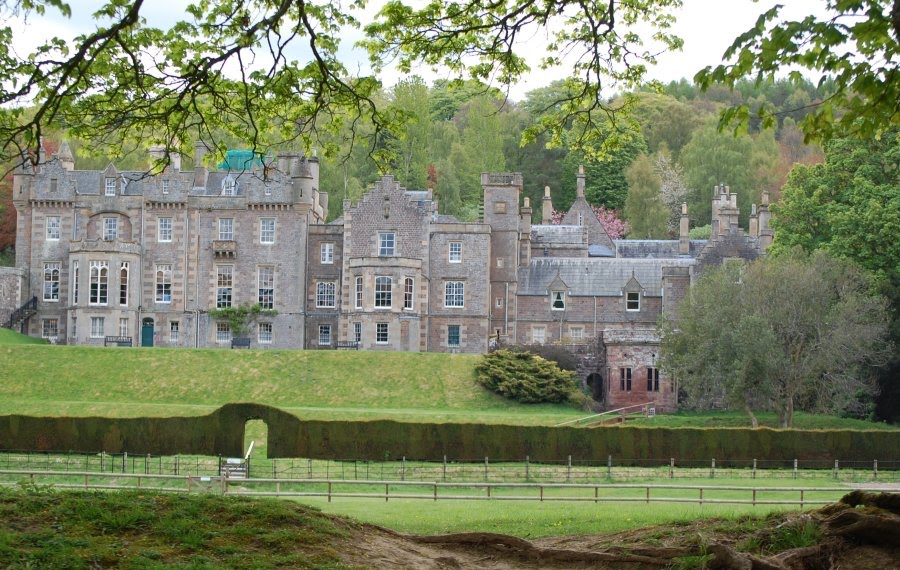
“Clausus tutus ero” is Latin for “I am safe when I am enclosed.” This is the motto of Abbotsford, Scott’s home and labour of love from the day he bought it in 1811 to the day he died, his bed having been moved into the dining room so he could look out over the Tweed and hear the sound of the water brushing the banks.

It is safe to say that there was no man as influential in establishing the story of Scotland than Walter Scott. Scott was a proud collector of artefacts that supported a romanticised image of Scotland and the “noble savages” of the Highlands. The entrance porch of Abbotsford House was built to resemble the one in Linlithgow Palace, while the ceiling in Scott’s library copies the one from Rosslyn Chapel.

Scott’s vast collection of beautiful items includes Napoleon’s pen case and a clock that is said to have belonged to Marie Antoinette. The armoury contains both Rob Roy’s broadsword and rifle, as well as his sporran.

On one wall hangs a set of dark, heavy keys that are reputedly from Loch Leven Castle, and in another room there is a lock of Prince Charlie’s hair. Sitting in Scott’s personal study, which contains the desk where he did much of his writing, is the Robroyston chair, made from the roof timber of the building in which William Wallace was betrayed and captured.

Not all of the items Scott collected belonged to famous people. One of the most remarkable items on display at Abbotsford is a small crumbling piece of oatcake, drawn from the sporran of a Highlander who was killed at the battle of Culloden.
When the stock exchange in London crashed in December of 1825, Scott, who had been one of the wealthiest writers who had ever lived, was suddenly plunged into a quagmire of debt.

Not wishing to give up his home, Scott struck a deal to write himself out of debt. Thus began six years of relentless creative output, during which time he earned great sums to appease his creditors but which in the end also caused the decline of his health and ultimately led to his death at the age of 61.

Today the estate is run by The Abbotsford Trust. Along with keeping the grounds immaculately groomed and preserving the many historical artefacts, the trust diligently maintains the ambience of the home as Scott would have designed it. For example, the 9,000 books in the library are arranged in the order that Scott left them more than 170 years ago.
Abbotsford House is a love letter to Scotland built from stone. So much of Scott’s passion for Scotland and especially the borders, went into the decoration of the rooms and the display of his many historical treasures. As a visitor, it is impossible to stand in the dining room and look out at the same view that Scott would have seen during his final days, and not feel surrounded by his great adoration for this place.
Take your time when you visit. Take time especially to walk down to the river and just sit and watch the water, listen to the gentle hiss and burble of it over rocks and earth. When you turn you will see the tree branches framing your view of Abbotsford House, which stands steadfast and lonely, as if it has been waiting all these years for him to come home.
*All photos included of the interior of Abbotsford House have been graciously provided by the Abbotsford Trust. Click here to visit the official Web site of Abbotsford House.

25 Apr 2010

A rare glimpse inside Kinneil House

Easter is the turning point on the Scottish tourism calendar. Around this time the clocks move forward and most of the historical properties that have been closed since October fling open their doors for another season. The days are longer, the air is warmer, and I am struck with a desire to see everything possible before the months roll quickly by into winter again.

Being on Historic Scotland’s mailing list helps me keep up with unique opportunities to see properties that are not often open to the public.

This weekend I couldn’t pass up a chance to go to Bo’ness and see Kinneil House, which is only open to the public on a handful of weekends each year.

This was the seat of the powerful Hamilton family, stretching back to 1314 when Robert the Bruce gave them the estate in thanks for their support at Bannockburn. In the late 1500s it was the home of Anne, Duchess of Hamilton, who lived there with her husband, William Douglas, the Earl of Selkirk.

Centuries later in the 1930s, with the house in desperate disrepair, the local council decided to knock it down.

They had already gutted the tower house and were poised to start smashing through the palace when they uncovered intricate paintings on the walls, which turned out to be some of the best examples of renaissance wall painting in Scotland. The house went from the chopping block to being  a prized historical gem.

The paintings are so fragile that Historic Scotland is strict about not allowing photography inside (they trust no one to leave the flash off), so the photos I have I had to scan from the brochure.

My favourite room is the Arbour room, the bedchamber of the James, the second Earl of Arran, who was responsible for the palace being added to the main tower in the 1550s.

The original paintings are lush and extravagant. I can imagine what the room would have looked like when it was still new, bedecked in the finest furniture and linens and dripping with opulence at every turn.

It is hard to believe that subsequent owners (including the Duchess) covered up these paintings to suit more “modern” styles.
It was the parable room that saved the house. Chipping through the panelling that had been applied during Duchess Anne’s time, workers discovered the story of the Good Samaritan sweeping around the walls.

Looking at the image of a man being attacked, I marvelled at the violence of it and wondered how much more startling it would have been before the colours were faded by time.
To round out the visit to the house the “Duchess” herself was on hand to tell the story of her life, from being thrust into a position of vast responsibility at the tender age of 19, to bearing 13 children and going on to live to the ripe old age of 85.
It was a gorgeous day and as the actress told the story of the Duchess, the air around us swelled with the sound of birdsong. Afterwards there was the massive estate still left to explore, from the green glen of Gil Burn where James Watt once lived in a cottage while he worked on his steam engine experiments, to wide green fields that no longer bear any trace of the original village of Kinneil.
Only part of the Kinneil Church remains, while the original bell is housed in the Kinneil Museum.

I never get used to the site of graveyards like this, so long forgotten. The heavy stones were once laid down as a sign of the eternal, but now they look fragile, grass and flowers breaking through the cracks as the earth slowly swallows the last remnants of memory.
Not far away is the excavated site of a Roman fortlet and the fading remains of the famous Antonine Wall, built in 140 AD. That date seems such a simple thing to say, but when I was planning my visit I had only thought about the house and had no idea of the vast layers of history that drape over this landscape.
Despite spending the better part of an afternoon at Kinneil, I left feeling overwhelmed due to being unprepared for the sheer amount of information available about the area. I wanted to know everything, but I didn’t know where to start.

The only negative sensual influence of the day was the inconsiderate way some of the Historic Scotland staff parked their cars right in front of the house they were supposed to be showcasing, essentially ruining wide angle shots for eager tourists who had travelled to see the Estate. If you are a tourism provider, this is common sense. Think of what the customer wants to see and don’t get in the way!
That said, I would highly recommend a visit to Kinneil Estate, which unlike the house is always open and also features great walking trails and countryside views. Add it to the long list of places I want to visit again.

**wee update** I have received some great correspondence from Historic Scotland who understood my photo-geek disppointment regarding the cars. I appreciate the gracious nature in which they took feedback and their desire to always be improving the visitor experience. Many thanks to Historic Scotland and the volunteers of Kinneil House for a great day. :)

14 Apr 2010

Leading you by the nose to Traquair

There is something important you need to remember when you visit Traquair House. It is this:

You can reset your nose by sniffing your skin.

I only learned this fact yesterday. Had I known it before stepping over the threshold of Britain’s oldest continuously occupied house, it would have saved me from wandering in and out of the rooms like an addict looking for another hit.

It is widely known that Traquair was used as a hunting lodge for kings and queens, and later as a safe haven for Catholic priests during the days of the Jacobite uprising.

The house is also recognized as a valuable piece of Scottish history, for its collections of artefacts and in the way the Traquair Brewery has sought to revive the traditional ale making techniques that were used there in the 1600s.
What is not widely known is that Traquair House smells amazing. Indeed, it is the best smelling house I have ever visited.

Every room seems to tell the nose a different story, from the cool stone scent that wraps around you when you enter the long hall to the vaulted cellars, to the stewed incense-like aroma of oil paint, wooden beams, and the ghosts of fires that once burned in the grate, which hovers in the high drawing room in the same way dust appears to be trapped in sunbeams.

Also, whoever among the staff thought to put the enormous vase of lilies in the lower drawing room that is attached to the dining room, ought to be given a raise.
The entrance for these rooms is off the courtyard at ground level. Imagine the transference of fragrance stepping from outside, where the sun is warming the stones and the spring flowers and grass are pushing sweetness into the air, and into these slightly cooler rooms, which are blooming with the collective smell of oil paint, wood polish, and the syrupy whiff of aging fabrics. Overtop of all of this, float the siren song of lilies. It was, in a word, divine.
I had to walk out, take a turn around the courtyard and go back in again, just so I could feel my body go slightly limp with the pleasure of it.

If I had known about resetting my nose I would have simply sniffed my arm occasionally and stayed in the room for half an hour, despite the fact that the poor girl acting as the room’s guide would have thought I was a loony. Even loonies must have their pleasures, thank you.

I wasn’t allowed to take photos inside house but the folks at Traquair have forwarded me some images. There is just one I want to share, of the main library.
From this photo I think all book lovers can imagine what it smells like. Sweet old leather and the dust that has still managed to creep between the tightly pressed pages. I can’t be the only one with a desire to open a few of them up and let their aromatic secrets fill the room.

Several of the rooms include recordings made by the current owner. In a gentle voice perfect for storytelling, the 21st Lady of Traquair, Catherine Maxwell Stuart, takes visitors through the history of the items and interesting anecdotes from her family’s past.
My favourite stories include a visit from Mary Queen of Scots with her infant son, who would become King James IV. The cradle where he slept is at the foot of the bed in what is known as The King’s Room.

The other story that grips me is about the secret stairway used by Catholic priests and Jacobite refugees, prior to the Catholic Emancipation Act of 1829. The false backing of the cupboard has been opened to reveal the steep stairs behind, making it easy to imagine someone trying to silently sneak away while his room was being searched.

The one room that I expected to hold a heavy scent of history was the Catholic chapel, however it was as if those aromas had been scrubbed away. I later learned that this is because the chapel is above the brewery. The incredible beer that they brew here will be getting its own post.

It was too late in the day to get a decent photo of the huge maze at the back of the house, so I will introduce you to the resident goat instead. Everyone, this is George. George - everyone.
One last thing about the house. These are the Bear Gates, which have been shut since 1744, when the fifth earl of Traquair closed them following a visit by Bonnie Prince Charlie.

The Earl swore they would not be reopened until a Stuart king took the British throne. The grass has grown over the gate near the bottom, and everyone visiting the house continues to use the “temporary” access.
This house is magnificent. It is only open during the summer season, starting from Easter. During the off season it is still lived in by Lady Catherine and her family.

We will be sampling Traquair Ale in a forthcoming post. And if you don’t fancy a visit to this house already, I promise it will make you change your mind.

4 Mar 2010

A day out in Pollok Park

It was one of those clear, cold mornings that lasted all day, the sun nothing more than a distant and blinding pinprick of warmth. The kind of day when the frost hangs on in shadowy corners, straight through the afternoon and into the dark again. Without much time to escape the urban landscape, I left from Glasgow Central station and two stops later was a short walk from what in 2008 was dubbed the best park in Europe.

Once part of the Maxwell family estate, Pollok Country Park was gifted to the City of Glasgow in 1966 and is a pick n’ mix of natural and manmade features, quiet corners and interactive attractions. It is the largest park in Glasgow, is highly accessible and also a magnet for families looking for a cheap and cheerful day out with plenty of options for bairns and adults alike.

For children growing up in Glasgow, this park is likely the first place they will see one of their country’s most recognizable rural icons - the hulking, shaggy Highland Cow. I stood next to the fence and watched the plumes of frosty air burst from their nostrils as they stared into the middle distance and chewed their cuds. They were either the most bored cows I have ever seen, or having reached the zenith of their bovine yogic powers, they no longer felt the need to engage with their surroundings.
A short walk away lies Pollok House, an 18th century mansion that overlooks the meandering White Cart River. Run by the National Trust, the home is filled with beautiful paintings and a multitude of antiques, but the strict policy against photography means I cannot show you any images of my favourite rooms, being the drawing room and the truly lovely library, where the thick bound books are stashed away on tall shelves, the kind that require a small ladder to reach the higher volumes.

Less able to absorb historical facts than I am the feel of a place, I will report that my best moment in the house lasted approximately 30 seconds, which is how long I was alone in the music room with just the sound of the clock ticking. I imagined that was how quiet it must have been, once upon a time.
Like most people I adored the squat hedge maze that lies adjacent to the house. Children ran into it, quickly loosing the desire to find the centre and preferring instead to crouch down and attempt to hide from each other or their parents. Grown adults giggled madly as they hurried on ahead of their small dogs, who could not see their masters but sniffed them out or followed the sound of their voices until the inevitable joyful reunion.

Seen through the lion-guarded gates, Pollok House is a beacon of symmetry, but an explosion of black birds from behind the home gave an illusion of deeper drama, as did the elaborate comb-over of dead vines adorning a quaint garden house nearby.
Standing idyllically next to the river like something out of a Constable painting is the old sawmill, with an enclosed stable courtyard that made me think of Italy of France. I stood for a long time next to the water, using the reflection to increase the sun’s strength on my skin (it has been a long, cold winter and I am eager for warmth).
Despite its many romantic qualities, I have to say that Pollok Park is not my favourite. It is too car friendly for me, which detracts from that sense of a serene escape to nature that many urban dwellers need from time to time. But there is one more gem in Pollok Park that I will explore next time, a world of light and beauty that caught me completely by surprise.

21 Feb 2010

Off the map: South Queensferry to "the wild wood."

I am not, nor have I ever been, a proficient map reader. It’s not that I am incapable of following directions, it is more that I am easily distracted and a lover of simply seeing where a new path might take me. Because of this, my relationship with Kerry Nelson’s small and charming guidebook, Edinburgh: 40 Town and Country Walks, is suffering.

Twice my friend Craig and I have used this guidebook and twice we have gone the wrong way after failing to pay close attention to the directions. The first excursion was meant to take us from Aberlady Bay Nature Reserve to Gullane, however we turned too soon and ended up having to traverse "the second biggest golf course" Craig had ever seen. At the time I was certain one of us would be brained by a wayward ball.

During his most recent visit to Scotland‘s fair capital, we gave the guidebook another try. This time we were meant to walk from South Queensferry to Cramond Brig.

Things started off well. We took the train to Dalmeny and found our way down to South Queensferry, whose long harbour is dominated by that beautiful red mammoth of engineering, the Forth Rail Bridge. The path took us along the water and then inland where the bare trees and faded colours made me forget about the promise of spring and think instead of Halloween and the heavy cloak of autumn.

We checked the book several times to assure ourselves that the dotted line on the map at least vaguely resembled the path we were following. Eventually we made it past Barnbougle Castle where we spent a few moments gazing at the tower house, which loomed through the trees at the end of a private drive. All the while we lamented the fact that neither of us are likely to ever live in a castle, and we tried desperately not to feel bitter about this whole sorted deal called life.

Seeing Dalmeny House immediately distracted me from my woes, as any 19th century gothic revival mansion set on wide green lawns and overlooking an expanse of water is likely to do. The house is only open to the public on set days between May and July, and only then as part of guided tours, so I had to be content to wander around while trying to dodge the plays of nearby golfers (who sets a golf course next to such a valuable (and many windowed) property?). Next to the house is the life-sized bronze statue of King Tom, a thoroughbred racehorse and super stud (“leading sire” if you prefer the more genteel term), who died in 1878.
This was where we went wrong. Had we read the directions beneath the dotted line, we would have noticed the express instructions to “turn left here,” which would have led us back to the water for the remainder of our coastal walk. Unfortunately the guidebook map only shows one trail, as if no other trails or roads have or will ever exist in the real world. For creatives who measure things in relation to other things (ie "how big is your frying pan? Could a cat curl up in it?"), this presents a problem.
We trudged along on the muddy track, past trees whose sap seemed to have turned to ink, and Craig joked that he no longer needed to watch the film of The Road, because he “had lived it.” We took the sight of houses in the distance as a promise that if we kept walking, we would eventually reach a main road and a bus stop. We followed the power lines, past wide fields containing isolated trees, until finally we arrived. Exactly where we arrived I cannot tell you, except a sign post of local trails described where we had just come from as the “wild wood.”
Overall it was a fantastic day out, and I am far from giving up on Edinburgh: 40 Town and Country Walks. I just resolve that from now on, I will read the directions and not just try to follow the lonely dotted red line through the landscape.

  © Blogger template 'Isolation' by Ourblogtemplates.com 2008

Back to TOP