Showing posts with label graveyards. Show all posts

16 Jan 2011

Dreaming of spring in Rob Roy country

Thank you for the many kind suggestions on how to beat my winter blues. I am slowly starting to feel settled again, but one suggestion in particular has rooted itself in my mind. Wayne suggested posting some photos of Scotland in the spring, which is exactly what I have decided to do.

So let’s fast forward through the rest of the dark season and walk out into the new fresh world of spring, returning to Balquhidder Glen in time to see the daffodils blooming next to the gravestones in the churchyard.

This small churchyard is where Rob Roy is buried, along with this wife and two of his four sons. Their graves are alongside the gravel path and are surrounded by a metal rail with markers of their deaths (though I have read that the age of Rob Roy’s death shown on the marker is wrong, and that he died at the age of 63, not 70).

Rob Roy’s life has been extensively romanticised over the centuries, starting with his first appearance in Daniel Defoe’s “Highland Rogue” which led to a royal pardon for the famous cattle rustler. After his death, Sir Walter Scott’s novel “Rob Roy” brought the story to a wider audience, and Hollywood has gone on to cement his fame.
Compared to the rest of the churchyard, which contains the ruins of the original church and old gravestones surrounded by swathes of lush green grass, the burial site of the MacGregor family seems run down and somewhat sad.

If you are intrigued by the Rob Roy story, it is understandable you would want to see the place where he is buried. But I would encourage visitors to the Trossachs to avoid the trap of just stopping by the Balquhidder churchyard as a way to check something off a “to see” list. The experience of Rob Roy country (as the Trossachs are often called) is to be had by getting out in the countryside that MacGregor would have spent much of his life.
Even a short walk on the trail that leads off behind the church will get you beneath the trees with the sound of the river over rocks. Or if you have time you can create a more intimate holiday experience by walking the 79-mile Rob Roy Way.

This was just what I needed. I can look at these photos and almost believe that the next time I walk outside I will see the trees sporting swollen buds and be able to smell that sweet, new-life scent in the air.

If you could wake up anywhere in Scotland at the height of spring, where would you choose?

31 Oct 2010

Haunted Edinburgh: Greyfriars Kirkyard

The following is my fictionalized version of the true story of a homeless man falling through the floor in Lord George Mackenzie’s tomb in Greyfriars Kirkyard in Edinburgh.

Edinburgh. December, 1998:

He was soaked through four layers, his body aching from an epicentre in his belly. At any moment it felt as if all of his insides would abandon post and blow up, crash through his bones and skin and splatter into the cold air. Anything to spread a little warmth.
It is easy to stay to the shadows in a graveyard. Greyfriars must breed half of Edinburgh’s winter gloom, a parade of silhouettes slithering out from the womb of stone and moonless sky.

All the same he kept to the sides, trying the gates of each tomb as he went. Finally, one tomb so black it could have blended into the night. But the gate had not been locked, and inside the cold seemed at least to be holding still. It would do.

With palms flat against the stone and eyes wide open like funnels sucking in the darkness, he made his way towards the back of the tomb, to find a quiet corner and wait out the storm.

Clunk. His foot moved from the earth to what felt and sounded like wood. Impulse made him lift his left boot and bring it down three times, like a knock on a door.
Knock knock kno…

And he was gone, his mouth opening in a silent cry as he fell through the rotten floor, taking damp earth and stones with him. A moment of chaos and clamber, then nothing. He retched himself up to sitting and breathed into the ballooning silence.

He had fallen onto uneven ground, which poked into him and made it difficult to find his balance. His hands slipped around, trying to make sense of it all.

Even in the dark, there are bones the shape of which are so familiar that we can build the picture in our minds of their place on the skeleton. Now he was surrounded by them, his fingers moving over skulls, over the linking charms of finger joints and the batons of fibula. His imagination doused the scene in the green slime he knew was there, because he could feel it clinging to him.

He screamed as he reached up and through the jagged hole where he had broken through, his dirty hands emerging into the gloom like a shock scene in a horror film. Two hard pulls brought him back to the surface, and as soon as he found his feet he began to run. He hurled straight through the graveyard this time, towards the nearest lamp which illuminated the falling rain. A light to erase the shadows, the rain promising to wash everything away.
Did you like that? Since that fateful night, Greyfriars Kirkyard has never been the same. Because you see, it seems that someone, or something, was unleashed when the man fell through. The unfortunate man claimed it was the evil ghostly energy of none other than Mackenzie himself.

The reports began almost immediately. People visiting the area told of how they were attacked by something they could not see. Often their hair was pulled, or they suddenly lost consciousness, despite having no history of such occurrences.

Scratches and bruises appeared on their arms and legs the day after visiting the site. An exorcist even had a go at ridding the place of what had become known as Mackenzie’s Poltergeist. The exorcist said it was not possible - the energy was too strong, and he feared for his life. A few weeks later he died of a heart attack.

In this age of concern for public safety, Edinburgh Council thought it best to close off the area entirely, until a ghost tour company convinced the council to let them lead small groups of people into the tomb while telling visitors the history of the area. (Mackenzie’s tomb is on the left down past the locked gate. There is no way in now without an official guide).

Now I’ve been on the City of the Dead tour, and it was, as JP would say, wank. They stuffed a dozen of us into the black mausoleum and made us wait there in the dark to see if anything would happen.

We all stood in silence, some of us hoping, willing this demonic ball of energy to graze our necks with icy licks. Nothing. Well, until one of the tour guides jumped out like a bogeyman in an attempt to illicit some screams. Talk about ruining the vibe.
Never mind. The story -and all the unanswerable questions - are what matter. For example, why Mackenzie? Was it because during his years as a lawyer he so mercilessly persecuted the Covenanters, who chose Presbyterianism over the crown’s favoured Episcopacy?

His relentless cruelty toward them is why he became known as “Bluidy” Mackenzie. How high and mighty of him - sending down all those poor folks for their beliefs. How very awkward for him then to eventually be buried in the same ground as many of those who died as a result of his prosecution. Perhaps that is the cursed friction that keeps him spinning out of the grave.
Greyfriars Kirk is my most beloved graveyard, simply because it is so creepy. I love the dancing skeletons and the giant tombs. I love the gravestones that look to be slowly sinking into the mud. 

I should add that the reason there were so many bones under the floor was the churchyard was apparently the home to many unregistered burials during the plague. The number of headstones in the graveyard is estimated to be just a fraction of the number of bodies underfoot.

If you fancy reading more about the ghouls and ghosts of Scotland’s capital, pop over to Edinburgh’s Dark Side.

I’ll haunt you later…(oooooh...chocolate eyeballs!)

18 Oct 2010

The broken splendour of Arbroath Abbey

Arbroath Abbey is a field of massive stone shards, rusted dominos that rest together like old men who have known each other for more years than any of them can remember.

At one time the abbey was one of the most impressive buildings in medieval Scotland, 90 metres long with a trio of towers meant to inspire awe and reverence.

Today the grave of the abbey’s founder, William the Lion, lies exposed among the ruins of the nave, the carved words “King of Scots” flecked with fresh grass clippings.
But the gaze will always be drawn towards what it finds most beautiful, stopping there to help the imagination rebuild what time has torn away.

At Arbroath it is what the locals call “The Round O,” a large circular window in the gable of the south transept. At one time light would have poured through stained glass, and even today the afternoon sun seems to target the orb, producing a lighthouse-like glow through the empty eye.
For those with a love of doors, you may stare longingly at the one on the other side of the south transept.

With its hinges and handle still intact but its stairway long gone, this door in the sky looks like something from a fairy tale.

If we could just climb up to open it, perhaps a mysterious rush would fill our ears and we would find ourselves in 1233, listening to the murmured echoes of the monks preparing for services in the sacristy.
The sacristy is the only part of the church which remains roofed. It is closed to the public, but it is said to have some of the best acoustics of any building in Scotland.

The guest house and the abbot’s house are squat and sturdy, having survived much of the deterioration suffered by the bulk of the abbey.

Inside the guest house is a copy of the Declaration of Arbroath, when the Pope was asked in 1320 to recognize Scotland’s independence from England and to acknowledge Robert the Bruce as the King of Scotland.

Push a button on an interactive exhibition and a sombre voice will fill the room with readings from the famous document.
“As long as but a hundred of us remain alive, never will we on any conditions be brought under English rule. It is in truth not for glory, nor riches, nor honours, that we are fighting, but for freedom - for that alone, which no honest man gives up but with life itself.”

A short repose in the graveyard is necessary before any visit to the abbey can be considered complete.

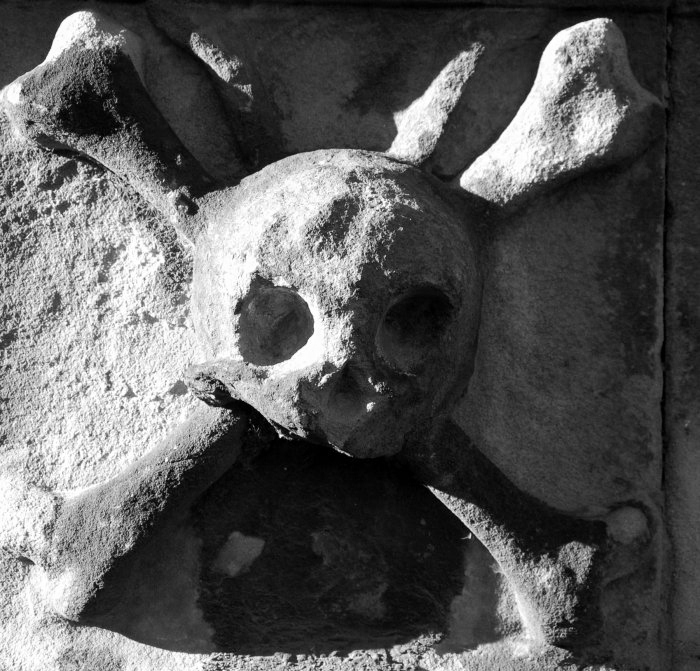
Tall trees nestle against high stone walls, buffering external noise and filtering in a sweeping calm through the gravestones. Walk the rows searching for names and dates, tributes to lost love or the stamp-like skull and crossbones that seems to say “death was here.”
One special gravestone has been taken inside the abbey’s modern visitor centre, where it is protected from the elements and perched on a wall at eye level. On the left, an old woman leaning on her stick, and on the right, Death holding an arrow or “sting.” (1 Corinthians 15:55 “O death, where is thy sting? O grave, where is thy victory?”)
Even in the bright sunlight, no church or abbey that I have visited has made me feel as sad as Arbroath. Only because I know how beautiful it would have been, once upon a time.

I yearned for the walls to reappear, to grow out of the ground, perfectly carved stones clicking together. I wanted to see long shadows forming over the gravestone slab of William the Lion, blanketing him in cool calm, an offer of long, nourishing rest.

However a gentle smile reappears when I cast my mind back to the Round O and the strange trick of the light through its invisible lens. Glowing hot and vibrant as it always has, as if it has never realized it is broken.

22 Jul 2010

Breathing space at St. Cuthbert's


It is summer in the city for me. With festival season looming, the daylight hours are filling up with work and thoughts of even more work.

Life becomes about trying desperately to be less jealous of Alex and Bob’s blue sky adventures, and more focused on finding small pieces of breathing space.

There is a beautiful graveyard on the corner of Princess Street and Lothian Road in Edinburgh, which belongs to the Parish Church of St. Cuthbert.

With constant traffic rumbling past on two sides, this churchyard still feels like a tiny haven, a place where nothing has moved for hundreds of years.

In high summer, the sun seeps through the leaves and lands on gravestones flecked with moss and the surrounding carpet of green grass.

On a windless day, if you ignore the sounds from the nearby roads, it can seem like a snapshot of photosynthesis, that pause between moments when everything just stays put. Tiny pollen grains seem trapped in sunbeams like snow in a snow dome and I expect to see the bees suddenly freeze in mid-flight.
Aside from services, the church itself is only open to visitors in the summer months, but the graveyard is open all year. In the winter it encapsulates Edinburgh’s perfect gloom, and in the summer it still retains those precious shadows. It is one of my favourite places in the city.

My other favourite place at the moment is at home, where my Scotsman and I have just passed our second week of shacked-up domestic bliss. It is very, very good.

So just when the days are longest and Scotland is humming with beauty and numerous festivals and activities, my senses are otherwise engaged. I will however be attempting to share the odd post and keep reading about the adventures of fellow blogger whenever possible.

To those who have been reading along with Magnus Magnusson’s Scotland, Story of a Nation: It would seem I have failed you. My intentions were good, however I think I should have started this quest in the autumn instead of the busy spring. I remain hovering around Page 200. Luckily my friend Susan is still ploughing through and is posting updates on her progress. As for me, I will finish - eventually. Forgive me!

14 Jun 2009

Haunted Scotland: So it's Death you want?

It has been a dark, stormy afternoon. The thunder has skidded across the heavens and the gloom is pouring into my living room. It has nothing to do with the drum roll for the whisky treats draw tomorrow. No, it is because Scotland is simply one of the best places in the world for deep shadows and whispered mysteries.

In the world of Google searches, the post in my first blog that most people land on is this one, about Greyfriars Kirk. I conclude therefore that many people yearn for the macabre, for the things that will make them shiver with just enough fear to get their heart thumping.

I have a small collection of graveyard photos, and since there is bound to be one among you who loves nothing more than walk between the headstones, reading the names aloud like they are pieces from a long lost incantation, I thought I would share them. The solemn angel comes to us from Rosslyn churchyard.

Then the popular Gothic beauty of Greyfriars Kirkyard, my personal favourite in Edinburgh:


Head to the coast and North Berwick, where the scalped remains of the old church presides over a showcase of worn headstones:
But if you visit no other graveyard in the country, make it the Victorian glory of the old Stirling cemetery, where the weathered stones seem to beg for someone to tell the stories of those buried beneath. For those from the USA, Stirling graveyard is also the final resting place of Butch Cassidy's grandfather.

Throughout the graveyard there are many stones featuring skulls and crossbones (which I love for their grisly drama), but the one that most clutches at my spirit is this one, massive and with no name, just the words "wee sister."


Not on any of the tourist maps, but this site near the Water of Leith trail in Edinburgh has an aura of calm that I always enjoy.
Next, the stern-looking monuments of the Glasgow Necropolis. It may seem a bit creepy to some, but this massive space, on a beautiful green hill behind Glasgow Cathedral, is a great place to pass a sunny afternoon with a picnic and a book. And should you start to hear voices from the tombs...well then you know it's time to pack up and head home.

Finally, another Edinburgh gem - the Dean Cemetery, not far from the Gallery of Modern Art. What makes this cemetery special is the claw-like limbs of the trees, but also the myriad of personalized headstones. It seems as if the dead are stuck, oozing between one world another. Below is painter Samuel Bough.

Do you have a love for the morbid that just won't let go? One of my favourite blogs for exploring Scotland's shady past is Edinburgh's Dark Side. If you are a story teller, it can be a great source of inspiration and character material.

The winner of the parcel of whisky treats will be announced tomorrow. Until then, sleep well (queue maniacal laughter).


  © Blogger template 'Isolation' by Ourblogtemplates.com 2008

Back to TOP